

The Real Political Bias of Sci-fi
Some writers describe American sci-fi as predominately conservative; others decry it as a den of leftism. Who’s right?

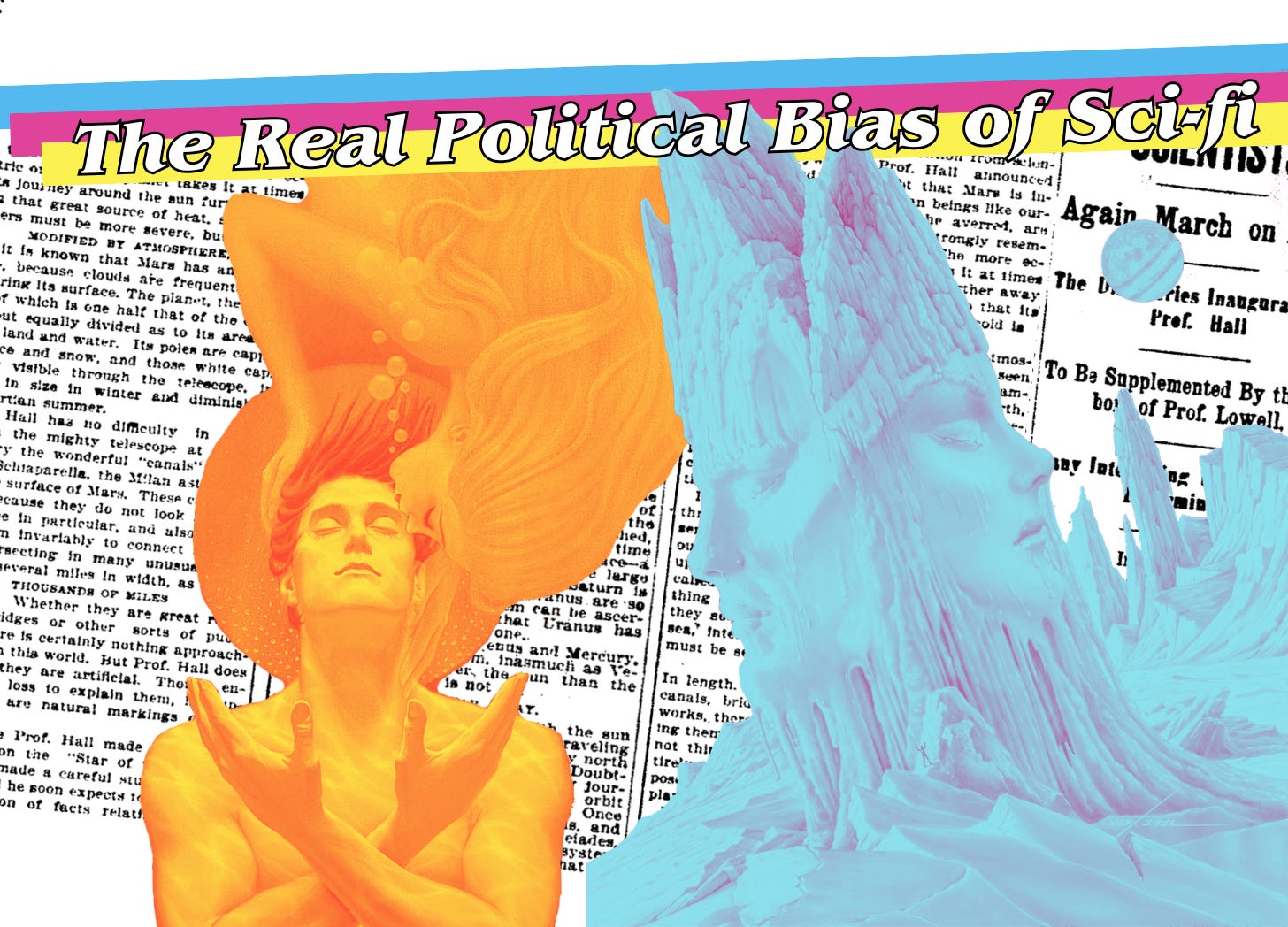
Illustrations from the vintage covers of Stranger in a Strange Land and The Left Hand of Darkness
As I’ve researched my measured rebuttal to J.M., I’ve ended up reading a bit about the Sad and Rabid Puppies. The Puppies were the Hugos Award drama of the 2010s, about “integrity in sci-fi writing” rather than “Chinese influence.” Different hysterias for different decades. Since the Hugos are decided by fan votes rather than a panel of judges, a group of motivated fans could determine the outcome, and the Puppies were nothing if not motivated.
The Puppies weren’t an ideologically unified group beyond a key point, which was that the Hugos had started to reward ideology over quality. That to say, these Puppies weren’t fans of N. K. Jemisin and Ann Leckie. Contemporary outlets likened this to Gamegate. Some similarities were remarkable, particularly since one outspoken Puppy played a sizable role in both.
But writers differed on key points. Mike VanHelder wrote confidently that “the Hugos have never been especially politically conservative,” but Hugo Awards winners themselves often disagree. For example, Lois Bujold didn’t view her work as overtly political. As Jason Sanford quotes in the previous link, the Puppies felt “that recent Hugo Award winners had made the awards worthless” and “defaced the legacy of Heinlein, Asimov, Clarke.” So who’s right? VanHelder, Bujold, or the Puppies?
Perhaps the question is wrongly framed. Though sometimes novels will be labeled as libertarian (Vinge) or Trotskyist (MacLeod)1 sci-fi, that’s not a subgenre unto itself, but a description of themes and perhaps the author. A Fire Upon the Deep may satisfy a Redditor asking for right-wing sci-fi, but that’s not what it set out to do. It set out to be a space opera.
Enter the Puppies

Why was Space Raptor Butt Invasion by Chuck Tingle — until then best known for being a meme, or perhaps performance art, about Amazon self-published erotica — nominated for a Hugo Award for Best Novel?
In general, histories of a genre can’t be written by looking at a list of award winners. Most awards are decided by committee, and consequently, they represent nothing so much as the taste of a few people.2 By contrast, the Hugos are awarded by a much larger group of people that anybody can join: WorldCon.
Sadly, Space Raptor Butt Invasion wasn’t nominated based on its literary merit. Its inclusion on the Hugo slate was a joke, one meant to protest the failure of the previous year’s Puppies nominees. Beginning as a blog post in 2013 where Larry Correia suggested bloc voting as a way to get his own works nominated, the Puppies quickly ballooned into a full-on fandom war, with hotly contested battle lines and objectives. For Correia and like-minded Sad Puppies, the Hugos were unjustly favoring “literature” over “pulp,” the latter of which is the true sci-fi.
This first blog post was written in January 2013, shortly after Redshirts by John Scalzi won that year’s Hugo at the December 2012 WorldCon. It’s hard to imagine that Redshirts represents literature winning over pulp, but there you have it. Perhaps snarking Star Trek was a bridge too far.
The greivances of these old-school fans had a political valence from the start. In his blog post on the topic, Brad Torgerson addresses this, stating the first purpose of the Sad Puppies as:
Get works and authors onto the Hugo ballot who might not otherwise be there; regardless of political persuasion. Think we’re just a crazy minority of right-wingers out to destroy science fiction? You’d be wrong. For instance, we’d love to see Eric Flint on the Hugo Best Novel short list. Eric is not only a popular author who does the genre credit with his work, he’s a card-carrying Trotskyite. A man who (unlike most slacktivist internet liberals these days) was willing to put his ass on the line for what he believed — back when identifying as a “red” was physically dangerous business in this country.
This argument is somewhat undercut by the sentence a few paragraphs before that calls the Hugo voters “niche, academic, overtly to the Left in ideology and flavor, and ultimately lacking what might best be called visceral, gut-level, swashbuckling fun.” Perhaps there’s a legitimate greivance, as Jason Sanford or Bryan Sanderson would have it, and the two “sides” of the fandom should try to reconcile. However, if Redshirts isn’t an example of swashbuckling fun winning Best Novel, then something else is at play.
Other political actors were perfectly willing to use the Sad Puppies movement as a pulpit for unabashedly right-wing politics. I am referring, of course, to Theodore Beale a.k.a. Vox Day. Like Correia, he benefitted personally from voting slates, ones he promulgated under the moniker Rabid Puppies. Unlike the more moderate Sads, Beale was and is quite forthright about his alt-right political views. He embodies the ironic racist channer routine we’ve all come to detest encountering online. Perhaps the most notable quote from the previous link is his defense of Anders Breivik:
Five years later on one of his blogs, Beale praised Norwegian mass murderer Anders Breivik’s “highly effective blow against the political machine,” and wrote that he could be considered a “hero.” Conceding that Breivik “did a terrible thing” by murdering 77 people, mostly children, Beale then argued that the children weren’t innocent, but “larval” politicians akin to Young Republicans or Hitler Youth.
“In any event, my expectation is that if the West, and Norway, survive the ongoing clash of civilizations, Breivik will be considered its first hero,” he writes.
This is one of the few moments in the profile where Beale expresses any genuinely-held beliefs without the defense of irony. He began the piece by saying he identifies as Native American and therefore a description as “white supremacist” would be culturally insensitive, but that’s only the foot in the door.
He has to boil the frog. Even a clicks-driven business like The Daily Dot wouldn’t continue profiling a proud racist after he admitted it in 2020. He has to play coy, to act like he totally doesn’t want the attention a profile in a respectable publication will bring him,3 so that he can give the real pitch to as many listeners as possible. The pitch: you can be a hero. If you help me push non-white degenerates out of the public sphere, then, when we win, everybody will know your name.
This is the sort of future-forward thinking we should expect from any sci-fi author who wants their work to age well. At present, that calculus is deeply political, and perhaps it always was.
Our two exemplars
Once upon a time, the Puppies claim, political rightthink didn’t win Hugos. Good stories did. Some Puppies saw themselves as defending “the legacy of Heinlein, Asimov, [and] Clarke,” and so it’s worth interrogating what that legacy was, precisely.
For our purposes, we’ll compare two past winners for Best Novel: Stranger in a Strange Land by Robert Heinlein (won in 1962) and The Left Hand of Darkness by Ursula K. Le Guin (1970). A comparison of only two novels can’t claim to be definitive, but juxtaposing these works, in particular, gives us the inside track on how sci-fi evolved. Stranger is classic sci-fi as the Puppies would have it, but Left Hand is undoubtedly the sort of “literature-over-pulp” they might decry.
When you read interviews or scholarship about classic American hard sci-fi, you run into a common refrain: “It would have been embarrassing if I got the math wrong on this.” This norm was set by Heinlein, Asmiov, and Clarke. To them, the purpose of pulp science fiction was to hem as close to the real-world science as possible while telling an exciting story, and half-assed science could only mean half-assed writing. The link between hard sci-fi and action packed stories persists today in Andy Weir’s work, perhaps the best modern example of hard SF.
Defining what lies beyond this definition is tricky. The natural opposite, “soft sci-fi,” isn’t a subgenre so much as a term meaning “not hard sci-fi.” Even though her picture is on the Wikipedia page for “Soft science fiction,” Ursula K. Le Guin’s purpose in writing The Left Hand of Darkness wasn’t to discard as much of the real-world science as possible. That’s an accusation made by uncharitable readers.

But Left Hand is hardly science-free. Though some of it has aged poorly, the same can be said for any sci-fi, for the same basic reason that any futurist prediction about the future can be disproven. Crunching the numbers didn’t immunitize Heinlein from this.
Nor is “soft sci-fi” uniquely interested in the social sciences. Stranger explores religion just as Left Hand explores gender, both works using their speculative elements to examine humanity under conditions not permitted by reality. Indeed, although Stranger is considered a classic of hard sci-fi, the scientific elements aren’t what makes the story tick. When Smith is hospitalized following his arrival on Earth, the suspense isn’t about the medical interventions necessary to keep him alive on a new planet, but the legal snare he’s found himself in. Smith spends the rest of the novel teaching Earth about Martian spirituality, not technology.
This isn’t to say their approaches are identical. Take for example Jubal Harshaw of Stranger and Estraven of Left Hand. The two fill similar niches in their respective narratives: they know the lay of the land, and guide our naive protagonists through the world, giving material aid and advice even as the law hunts for them. As personages, they couldn’t be more different. Harshaw is an eccentric libertarian polymath who refuses the title “doctor” out of a desire to avoid being confused with those “doctorates for comparative folk dancing and advanced fly-fishing.”4 Surrounded by beautiful young women, Harshaw is forthright about his hatred of the government, his love of himself, and his opinion on every situation. Estraven, conversely, is a politican who avoids ever speaking his mind. The protagonist he’s helping thinks of him as disgustingly feminine for most of the novel and, though he has no particular love for his government, he works for it as long as he can.
Le Guin’s Ekumen is not an optimistic projection of what our world will look like soon. Indeed, in the Hainish cycle our planet is destroyed, as we see in The Telling, and the characters are constantly constrained by technology, rather than liberated by it. Genly is unable to call in Ekumen reinforcements until the end of the novel for two reasons, one technological and the other sociological. That is, he can’t call in the ships both because his ship has been impounded by the Karhidish king and because it’s against Ekumen policy to make such a show of force. Though he cites the latter reason to other characters asking for proof of the alien ship in the sky, it’s the former that actually prevents an evacuation when the plot heats up.
Stranger, while never shying away from cultural critique, has a brighter outlook on scientific change. Heinlein’s Earth and Mars are embued with an incredible optimism about Heinlein’s own time and place. In the future, 1950s America will still be on top of the world. The science we have now only needs to be a little better to explore inhabited planets, and everything Earth already knows about Mars is true,5 if incomplete. Stranger is a story about the future written by someone who assumed technology would improve forever.
Heinlein and Arthur C. Clarke were engineers. Asimov wrote as much fiction as nonfiction, and was a professor of biochemistry. On the other hand, Le Guin was a historian. Philip K. Dick didn’t have a degree, but read a lot of philosophy.
Speculative fiction is something of an academic Rorsharch’s test. The same basic question — what would humanoid life6 look like on another planet? — can be answered by any discipline. How a given writer responds depends on what part of the scenario they want to speculate on, be it linguistics, chemistry, anthropology, or engineering. Dick’s interest in philosophy is transparent in works like The Three Stigmata of Palmer Eldritch, just as Heinlein’s expertise shines through in his speculation about future technology.
If a political divide seems to emerge, it comes from the differences between engineers and anthropologists. The divide is starker today than in Le Guin’s time, after a half-century of defunded humanities departments, but it’s not exactly a secret that (for example) engineers are a bit more conservative than the general public.
Heinlein, for his part, changed political allegiances several times throughout his life. Jubal can be read as a self-insert for him, especially given that neither personage believed “in doing his own thing and letting you do your thing. He had a definite feeling that he knew better and to lecture you into agreeing with him.”7 Though Stranger became important to the counter-culture movement of the 60s as an epistle to free love and fighting The Man, Heinlein’s politics are still evident on the page. After all, Harshaw still expects his women assistants to make dinner, even if they do throw him in the pool once in a while for complaining too much about their cooking.
Some feminist scholars have made similar critiques of Left Hand, whose androgynous characters are often seen in stereotypically masculine roles (like diplomacy and fishmongering) and rarely in feminine ones (like homemaking and childrearing). These critiques aside, Le Guin’s politics are also evident in her work. Left Hand is sometimes described as feminist sci-fi because its speculative elements argue that sex isn’t deterministic of a person’s character. This is hardly a belief shared by Heinlein.
The two works are still, at the end of the day, part of the same genre. That’s the reason for their many similarities, and their divergent points can be explained away as a matter of subgenre, personal taste, or authorial politics. Any argument that sci-fi is actually leftist or actually conservative founders on this basic issue. Sci-fi can be written by anyone, of any political persuasion.
Everything is soft sci-fi
Hard sci-fi has lost some of its splendour. Though not every sci-fi reader in the 60s was reading Heinlein, he did win five Hugos (tied for the most of all time), and his subgenre dominated the awards circuit. Now, sixty-some years later, pulp is an endangered species. Most expect the science in their fiction to be half-technobabble, half-metaphor, and would consider the detailed discussion of the setting endemic to Asimov and Heinlein to be excruciatingly boring.
This may be why those older classics are relatively unpopular with younger readers. While working as a library clerk, I helped with a stacks project increasing the number of sci-fi books on the floor. I started by looking at the Hugo Award for Best Novel winners, checking which were already on the floor, and adding the ones that weren’t.
I mostly found out that the person before me had done a good job. The winners left in the stacks — A Canticle for Leibowitz and The Moon is a Harsh Mistress, for example — were extant only in beaten, library-bound copies we’d owned since the 70s. Even if I put these on the floor, they wouldn’t be the object of many random checkouts. Everything, from their cover art to their prose, was out of style. The oil painted covers, though gorgeous, simply weren’t as shiny as the new books, and if a young prospective reader opened to a random page, the pulpy style was likely to put them off.
This personified a reality I’d already encountered. Only older patrons, who had probably talked to Heinlein’s wife on useNET in the 80s (FIND LINK), were still asking for and checking out these older volumes. Younger patrons did like sci-fi,8 but maybe one for every hundred would check out Asimov. Of our pre-2000s collection, only titles like The Left Hand of Darkness and The Parable of the Sower left the shelves with any regularity.
As I continued down the list, I started to realize important things about how sci-fi had evolved. A strange bifurcation had taken place. Even after the age of pulp ended, the style had its fans, scorning the “literary” in favor of “visceral, gut-level, swashbuckling fun.” And though Tor space operas won in both 1993 and 2013, A Fire Upon the Deep and Ancillary Justice have rather different approaches. Heinlein, once the Dean of Science Fiction, was forgotten by new readers in favor of Le Guin.
So, have the Hugos begun to favor “literary” sci-fi over “swashbuckling fun”? Basic methodological problems make this question impossible to answer in a Substack essay. For example, if we define “literary” as “more focused on social issues,” then Stranger would qualify. If Heinlein had been born about fifty years later, though, it seems doubtful he would have won Best Novel five times in his career. The bifurcation means that contemporary authors in his vein stand much less of a chance at both commercial and critical success.
Though politics don’t define the type of sci-fi one writes, they play an unavoidable role in one’s legacy. Ursula K. Le Guin was, as the blurb of Left Hand will often tell you, the first woman to win a Hugo for Best Novel. From 2010-2020, seven of the ten winners were women.
The Sad Puppies were sometimes met by sympathy from those who disagreed with their tactics but understood their greivances. Brandon Sanderson argued at the time that the Puppies were “a legitimately passionate group of fans, deserving of being listened to.” That’s undeniable.
Also undeniable is the fact that the Puppies were fighting for a version of literature that’s already dead. In the Puppies’ halcyon days of yore, most published writers were men. Today, most people in book publishing are women. Had the Puppies won, permenantly reversed the bifurcation, and made the Best Awards list look like it did back in Heinlein’s time, print sci-fi would be shockingly misogynist compared to the rest of publishing.
But the Puppies never formulated a vision of what sci-fi should look like, except that it shouldn’t look as it has for the past twenty-five years. I find this childish. Rather than a celebration of pulp fiction, the Puppy voting slates amounted to a multi-year long tantrum complaining that not everybody likes the same books. No one was discriminating against Correia’s work. It simply wasn’t that popular.
In the short term, that meant they failed. The Hugos voting system changed, and bloc voting is no longer possible. Without it, Correia and Beale haven’t again been nominated. Beale, for his part, still writes sci-fi, but has moved his grift to more profitable pastures, namely video content.
Legacy, interpretation
Earlier I mentioned that a sci-fi author has to spend at least some time worrying about how their work will age. Hard sci-fi futureproofed itself with as-plausible-as-possible projections about future technology. New Wave authors like Le Guin avoided making predictions about the future at all, instead writing about worlds parallel to our own. Today, you’d be hard-pressed to find a sci-fi novel published in this century that is set in a specific year. The now-comical dating of 1984 and 2001: A Space Odyssey serves as a warning against doing so.
Ultimately, when anyone speculates about the future, their politics play an important role. Whether they voted for Trump or Biden, you can find plenty of Americans on social media posting apocalyptic warnings about the future of the country. Strikingly, they’re chiral. Republicans believe that Democrats are Nazis who will castrate everyone and make Islam the state religion. Democrats believe that Republicans are Nazis who will end women’s suffrage and open concentration camps. Neither narrative interacts with the other. Both are told in the exact same way.
That one of these scenarios is more likely than the other doesn’t matter. Ideology is disconnected from material reality, and has a heft of its own. By virtue of taking up the same real estate online, both narratives are real, in that the words used to tell them really exist and can be read by anyone. True believers of online ideologies shoot up schools, mosques, and synagogues. They start harassment campaigns that bleed into the real world and disrupt careers. And, often quietly, they self-replicate. Newcomers are taught to believe the same way as the old guard. Print books are written, taking political ideas as gospel and enshrining them in archives around the world.
If I could quantify the exact relationship between fiction and reality, I wouldn’t be on Substack. Though I’m biased, as a sci-fi fan, I have a sneaking suspicion that speculative fiction, more than other subgenres, has a tendency towards prophetic. Science fiction is a dream about the future, and some of those dreams come true.
When a communist dreams about the future, she envisions a communist one. The same goes for a liberal, a fascist, and a libertarian. Any one of them can write a story about this dream, and spread it as far as readers will take it. It’s no surprise, then, that the Sad and Rabid Puppy campaigns were run without the possibility of dialogue. The fact that women and people of color could contribute to the discussion was itself intolerable. Sanderson said that the Puppies should be able to share their opinion “so long as they can do so without being hateful,” but very few of them were interested in doing so. Beale certainly wasn’t. It’s doubtful that the Rabid Puppies opinion could have been formulated without misogyny and racism, because their vision wasn’t about where sci-fi should go, but where it should return to.
The Puppies “failed” in that their nominees didn’t make much headway, and in that the rules were changed. Beale, for his part, likely made a pretty penny from the whole debacle, and certainly got a lot of free publicity. The frog got a little hotter.
Today, Le Guin’s school of sci-fi is more popular than Heinlein’s. It’s easy to think that’s a mandate for the future, that sci-fi will always be progressive, that Left Hand will always be a classic. But the reason it’s hard to write about the future is that the machinery of history moves slowly. It exists on the timescale of plants. The human eye can’t see change until the flower is already blooming, but it was growing long before that. It’s precisely this sort of shift that Beale was counting on when he spent several years making an enemy of everyone in the traditional sci-fi world. One day, he thinks, he’ll be a hero. In order to make himself one, he’ll trample over anyone else, likening better authors than himself to apes and harpies.
If you want him to be wrong, you can’t be idle. Read new releases and advocate for them when voting season comes around. Vote yourself, if you can afford the WorldCon membership. Write your own stories, read old books, and form your own opinions. Fiction is an arena for workshopping the world to come after this one. Conservatives know that and leverage it frequently, and other political paths — those of us who know women writers aren’t perverting the true form of sci-fi — should take advantage of it more often.
Not American but Scottish. The Star Fraction’s first half gave me weird dreams, which is pretty high acclaim to me.
Perhaps you could argue that this is why so many past Pulitzer and Nobel prize winners are virtually forgotten today, but if the many forgotten Hugo winners suggests anything, it’s that we as a literary culture just don’t produce a classic novel a year.
On his Wikipedia page, the first five citations link to articles in papers like The Guardian which quote him for a paragraph or two, mostly dating back to the Sad Puppies era. The whole point of The Daily Dot article, titled “Vox Day, ‘alt-right’ racist, is absolutely thriving online,” is that ventures like his publishing house (promoted by the Rabid Puppies campaign) are getting six-figure click numbers. This certainly isn’t an interviee unaware that all press is good press.
If soft sci-fi represents any group, it’s PhD holders of comparative folk dancing.
i.e., the Martian canals are real. That isn’t so unusual for Mars fiction. Stranger is on the tail end of this wave, to be sure, but sci-fi authors continued writing about the canals long after it was clear they were a trick of the lens. We love a good story.
To steal a term from Star Trek.
I, Asimov: A Memoir, 76.
... but not as much as they liked fantasy. You can see as much in the Hugo Award for Best Novel winners. Fantasy novels won rarely until the 2010s, and nearly exclusively since 2015.