


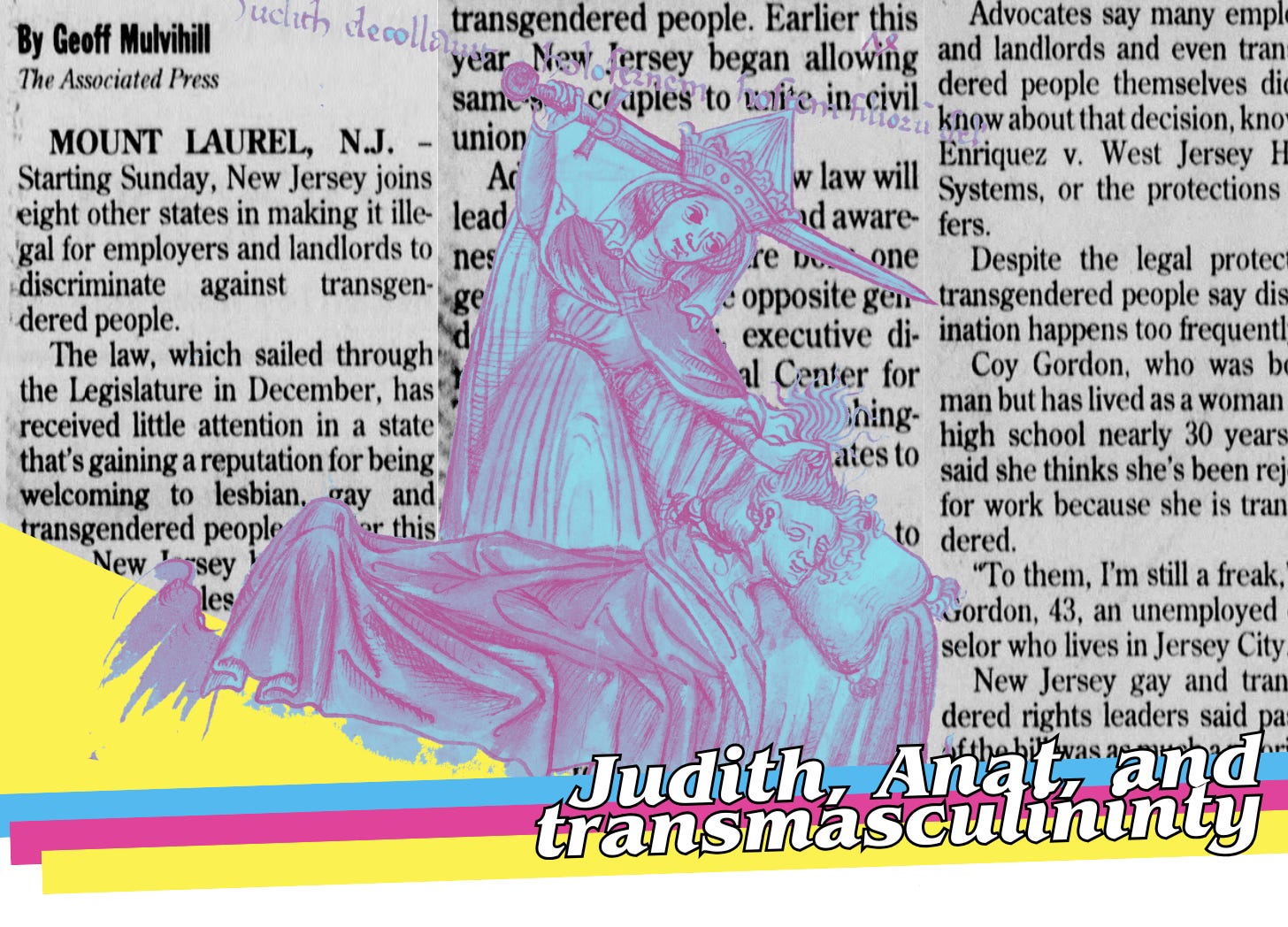
Years ago, in my many hours of reading about random topics, particularly about less-than-mainstream Jewish spirituality, I came across an interesting throw away sentence. In “The Hebrew Priestess”, Hammer mentioned the theory that Judith is in some way based on Anat, and that Judith has an Egyptian origin. Later, I read Neal Wall’s “The Goddess Anat in Ugaritic myth”, and as I wrestled with my rage at the author and fascination at the discovery he himself did not appreciate, I realized that perhaps there had been a transmasculine figure hiding in plain sight. And better yet, one who, like me, was alienated from the idea of transmasculinity.
Judith is the protagonist of a non-canonical book of Jewish scripture (though Judith is still culturally important to many Jews, and used to feature in Hanukkah celebrations). Nominally, Judith is a woman. Specifically, Judith is a childless widow, whose husband left them enough money and property to support themself for the rest of their life. The claim to fame of the story is how Judith seduces and kills Holofrenes, an invading general that threatens the ancient kingdom of Israel.
Anat is a Canaanite divinity and nominally a goddess, commonly considered to be a “virgin warrior goddess of love”, though this is disputed academically. Walls, in his analysis of the previous academic literature on Anat and presentation of his own opinion, argues that while Anat is certainly a warrior and a “virgin”, they aren’t a love goddess. At times some of his arguments to this end come off as contrarian. For example, he argues Anat and Baal didn’t have a sexual relationship in mythology, but one of the fragments he disputes because it doesn’t directly name Anat is hard to interpret any other way. The two main myths Anat features in are the story of Baal’s death and resurrection, and the Tale of Aqhat [Walls].1
A word before we go further: even if Anat and Judith do not have a proven direct connection that does not mean that comparing them is without value. I do not write most of my self published religious essays based only on an academic perspective. Academic research enhances them, but they are a mix of academic and devotional perspectives. The intention of comparing the two is not necessarily to prove something to the field of religious history; it is to see what we can learn by examining two figures that arose from the same region, albeit at different times.
Anat’s personality is suited to a warrior. They are strong willed, skilled in violence, and not shy about using it. One of Anat’s Ugaritic epithets is “Anat the Destroyer”. This personality is integral to interpreting their gender. Their temper is directly connected to a performance of man-ness. When Anat threatens to break El’s head open, the older god responds by remarking how much like a man Anat is. Walls, being a contrarian, translates away from the obvious and claims that stem for man actually means Anat is “uncontrollable”, referencing a possible Hebrew cognate. This is generally the theme of his book focusing on the then current research about Anat and their mythic function: simultaneously he brings up evidence strongly indicating Anat’s gender variance, but views Anat through his own cispatriarchal lens, and does not separate either his own patriarchal mindset or the Ugaritic one from analyzing Anat. The word “confused” or “confused gender identity” appears frequently in Walls.
In the Tale of Aqhat, Anat’s desire to be a man, to embody the masculine role, is embodied by the desire for a beautifully crafted bow. They offer to buy it from a mortal prince (Aqhat) but he declines. At first he tells Anat of the divine craftsman who made it for him as a gift, saying Anat should commission a new bow, but when Anat persists, he becomes rude, asking “what does a woman need with a bow?” For this, Anat seduces and then murders him. It is, however, all for naught: the bow is lost in the sea, and Aqhat’s death has a supernatural ripple effect, causing a massive famine. The bow is connected to both masculinity and fertility; in a West Asian context an object can itself be magically and symbolically connected to gender, with Ishtar (another war god) turning men into women by taking their bows and giving them spindles instead. Anat makes no commentary from the surviving fragments we have about questioning what a woman or man’s role is, and they do not assert their right “as a woman” to pursue what a man can. [Walls]
What Anat wants for themself is a symbol of manhood, to be the rightful owner of it, without the corruption of a craftsman making something with a woman in mind. Anat does not want to buy the bow. Anat wants to have been divinely given a “bow”- Anat wants for the other gods to have made them a man from birth. The text makes Anat’s gender the problem. This “woman”, desiring to be a man, not only causes disaster, but is doomed to failure. The symbol of manhood Anat desired is destroyed by his attempt to possess it. Anat is punished under patriarchy for going too far in his quest for manhood. It is one thing when Anat enacts violence that benefits cis men, as he does in avenging Baal; it’s another when Anat enacts violence for himself. This is not me projecting: this is the interpretation furthered by Walls himself. “Anat threatens the basic social fabric of the patriarchal culture as well as the life of Aqhat. Indeed, Anat’s ambiguous gender results in the death of not just any masculine male but in the demise of the royal heir. The suffering of the entire society is reflected in Aqhat through the languishing of nature in sympathy with Aqhat’s fate.” [Walls]
As Anat kills Aqhat, Judith kills Holofrenes. By killing Holofrenes, under the patriarchal system that we live in where combat is a man’s world, Judith proves themself to be “more” man than all the men in their city. It is only after Judith kills him that anyone else dares to take up arms and fight his now disorganized army. Further, beheading Holofernes has been interpreted as a metaphorical castration (Lewis).2 Similarly, Anat’s killing of Aqhat, because of the phallic image of the bow, can also be seen as castration [Walls].
Judith’s gender is even more conspicuous due to their position as a widow and as an adult “woman” without children. The fact that their name is Judith- literally “Jewish woman”- almost comes off as a reminder that we should definitely be thinking of Judith as a woman and not contemplate the gender transgressions too much, akin to Zeus taking a moment to scold Aphrodite for being present in battle.
While Anat never gives any indication that they feel anything other than revelry in their cosmetics, clothes, and makeup, this is not true for Judith. Judith prefers to live in an ascetic manner. This is also familiar to me from an Egyptian context as there are a few early Christian saints, some of them Coptic, who are transmasc. The most notable of these is Hilarion,: Hilarion was a child of the Roman Emperor. He chose to run away from home to a remote monastery in Egypt, claiming to be a eunuch and devoting himself to religion as a monk. He requested to be buried in his clothes and bedding so that no one would know his birth sex; unfortunately, one person knew of it anyway and spilled the beans.
A monastic or otherwise ascetic life occurs repeatedly in these early Christian transmasc stories, and it is no accident that it would be appealing from the perspective of the saints. Asceticism frequently involves casting away “frivolous” things (which, under patriarchy, often targets feminine ecotremont) and fasting. Fasting, especially to the extent sometimes depicted in art of saints, makes the body appear more androgynous by decreasing body fat. This is still an issue in trans spaces, with some trans people having eating disorders spurred on by dysphoria. And Judith is indeed, described as doing extensive fasting on every day except Shabbat and the day before, the new moon and the day before, and feast days. Judith does all this long past the religious requirement as a widow, indicating a preference for this lifestyle. While Lewis argues this is an expression of piety, this does not separate it from transgender performance, as is the case with Hilarion taking on a male name and living as a man while also living an ascetic life.
There is still some slight parallel to this in Anat’s identity as a hunter. Both hunters and ascetics live apart from society. In the ancient Mediterranean, hunter figures could be connected to both celibacy and hypersexuality. Such figures sometimes explicitly refused to take part in normative gender roles, and goddesses associated with the hunt or wild often were favored by women and “eunuchs”, i.e. a large category of gender variant people. [Walls] In Egypt, another goddess compared to Anat, Hathor/Sekhmet, is described as having “women-men” honoring them in procession- likely the contemporary way to describe gender variant people. [Egypt’s Returning Goddesses by Edward P. Butler] Elsewhere, texts refer to “men-women” in the context of goddess worship. [DePauw, Notes on Transgressing Gender Boundaries in Ancient Egypt] This terminology also reflects Anat’s “Male Lady” title. Unfortunately I do not have access to the original papyrus or a transliteration here, so I cannot confirm if the word used elsewhere for some trans people (man-woman) is used as Anat’s title.
Anat was also popular enough to be worshipped in Egypt- by both pagan Egyptians and Jewish Egyptians. Anat’s epithet “the Male Lady” is furthered as Anat is referenced as wearing a combination of women and men’s clothes, and being “a woman who acts like a warrior” [walls and the Chester Beatty Papyrus VII]. In Egypt, Anat is sometimes depicted as married- interestingly, to Set. Set is a god associated with chaos, war, and storms and as such was equated to Levantine storm gods, which may explain part of their association. Set is also notable, however, for being the only deity of the pre-Ptolemaic Egyptian pantheon that definitely has a queer sexuality. The god Anat is wed to by the Egyptians is the one that we know has sex with both men and women; in one sense this “brings Anat in” to the normative gender expectations of a woman, but in another it preserves Anat’s gender variance by matching them to a god whose sexuality (and possibly gender) is itself, “other” and non-reproductive. In fact, the very text that describes Anat’s masculine dress is one that discusses Anat and Set having sex (possibly non-consensually). Anat was popular among the Elephantine Jews, where they called them Anat-Yahu. Anat does not seem to otherwise appear in Jewish literature or culture, despite attempts to uncover such references (van der Toorn).3 However, the discovery of a figure of them in Gaza, Palestine means they were not unknown to Jews or Canaanites in Antiquity.
It is dubiously possible that Anat-Yahu is referenced indirectly in scripture. Jeremiah condemns a group of Jews for worshipping the “Queen of Heaven” (a title held by many goddesses), some of which had moved to Egypt. He prophesies their doom. This group of Jews tells him to sod off, and their fate is never mentioned again- giving no indication Jeremiah’s prophecy coming to pass. Jeremiah lived in the 7th and 6th century (not quite contemporary to the function of the Elephantine Temple; its earliest record is 525BC, while he died in 570BC) but most of Jeremiah was composed later, with the relevant section possibly being written as early as 540.
While the more likely identification with a “Queen of Heaven” worshipped by pre-monotheistic Jews would be Asherah or Astarte, who are more strongly associated with such a title, the mention of Egypt is conspicuous. No worship of Asherah or Astarte is known among Egyptian Jews; however, worship of Anat is. Additionally, all three are sometimes called “Lady of Heaven” in Egyptian texts. While Anat is not a “woman”, feminine titles are often still given to them due to how their gender has been perceived in cisheteropatriarchal society. One interpretation I have read was that this “Queen of Heaven” was not so much another god as it was the identification of G-d as “feminine”.
We know little about how “Anat-Yahu” was perceived. While the hyphenated name is commonly interpreted as “Anat of Yahu”, it is also possible that it was intended to refer to a hybrid deity- similar to the common Egyptian practice of blending two gods to create figures such as “Isis Aphrodite”. While some have assumed that the Elephantine Jews would have been very guarded against outside influences (van der Toorn), the fact they intermarried with native Egyptians and swore oaths with the names of other gods makes this seem less likely. The idea of Anat here being a hypostasis (essentially, an emanation, the way Kali is often an emanation of Durga or the way a square is a rectangle) is currently rejected, but without religious literature to analyse I think this is hasty. Just because a religious practice is true among a group of people in one region does not mean it will necessarily be true for the same group of people in a different region, hundreds of years later and exposed to new ideas. Even if not historically true, it can be interesting to contemplate in a modern theological context.
With this, we return to our beginning. Is Judith based on Anat? Did Judith come from an Egyptian context?
I find the argument that Judith was based on Anat, or that they are in some other way related through a fusion of ideas in Egypt as it was first fully presented problematic: for example, the original theory mentions a community of Jews of Samaria at Leontopolis, which does not occur until the time of the Oniad Temple centuries later (and, these Jews were not specifically from Samaria). This is used to argue that Judith was first written at Elephantine and translated into Greek around 146 BC to encourage Oniad Jews to defend their temple as they had defended the Elephantine Temple, presuming the two communities are connected and that therefore the Oniads remembered and cherished Elephantine. This completely lacks evidence. While the letter between Onias and the Pharaoh implied there were localized Jewish temples in Egypt (part of Onias’ persuasion to build his is as a centralizing measure) no known Oniad literature references Elephantine. The two temples are in completely different parts of Egypt, and the Elephantine Temple was likely destroyed around the beginning of the 4th century BC. The supposition that some Jews of Elephantine had descendants that later integrated into the Oniad community is possible, but currently unproven. Even if such a thing did happen, the memory of Elephantine may have been distorted or lost, and it is dubious if any religious tales would have survived the interim.
The reformulated theory rests on slightly different grounds. It does posit that some or all of the Jews of Elephantine originated in Samaria, and notes that Judith is sometimes analyzed as being pro-Samaritan. The context of what “Samaritan” meant, however, is completely different before and after the rule of Cyrus the Great. Going by the Rabbinic history, the difference between Samaritans and Jews arose when Jews returned from Exile under the rule of Cyrus. The Samaritans claim an earlier date during the life of Eli in the 11th century BC [Fried].4 Archeologically there seems to have been continued cohabitation and no severe schism into the Achaemenid period. However, with the establishment of the Samaritan Temple, a rift seems to have grown until a Hasmonean destroyed the Temple, setting the schism into stone [Knoppers].5 This is not implausible, as Anat was likely more popular further north in the Levant around the region of Syria and Samaria (now Northern Palestine) (van der Toorn). This argument is furthered by finding parallels to Anat and Astarte in the story of Deborah and Jael, which has a northern origin and resonates with the story of Judith. These parallels as argued are plausible but not absolute.
The problems arise as the reformed theory argues that Judith reflects the events of the destruction of the Elephantine and Oniad Temples, and that “Jerusalem” in Judith metaphorically refers to any city with a temple. There simply is no specific parallel aside from a threat to a temple. We have little information to clarify exactly how the Elephantine Temple ceased operation, but it likely was not an invasion-type event. The closure of the Oniad Temple was done by the Romans, making it more similar, but it isn’t clear what was going on in the community of Oniads at the time or how the Romans who came to destroy it interacted with them. Finally, I find the idea that Oniad or Elephantine Jews would use “Jerusalem” that way dubious. Two of the literary works we have that likely originate among the Oniads (Joseph and Asenath; 3 Maccabees) are not at all shy about identifying their events with Egypt and referencing a Jewish temple in Egypt. 3 Maccabees does use parallelism between events in Jerusalem and Egypt, but it does not call the site of the Egyptian temple mentioned near the end “Jerusalem”.
As for the additional evidence: The presence of Assyrians at Elephantine and in Judith is indeed notable. The Elephantine Jews were likely displaced by the Assyrians and mainly served the Persian Empire, and Judith portrays antagonism between Jews and Assyrians. The Jewish women of Elephantine did enjoy more egalitarian status (and, I would add, there is some implication of Oniads also giving women a more equal status) that would lead to “female” protagonists in religious tales. The rest of the evidence simply isn’t very strong. At most, the reformulated theory proves Judith likely had a northern author and was influenced by Deborah and Jael, and that the latter two were also influenced by Anat. It doesn’t prove a direct connection between Judith and Anat, and it doesn’t prove Judith was originally written in Egypt.
What constitutes being a woman? Ignoring its obsession with genitals, the cisheterosexual world responds: a mother, a wife, an “angel of the house”. A woman who does not marry is “incomplete”, imagined as a miserable spinster who will die alone. For this reason, there are many lesbians who are nonbinary: society does not view them as “real women”, and they primarily understand themselves as lesbians. In the early days of sexology, this also held true- gay men and women were “inverts”, and gay women were sometimes described as having men’s souls. This was not rejected at the time: Radclyffe Hall wrote “The Well of Loneliness” as a lesbian. The protagonist of the book is a masculine lesbian who identifies as an invert, just as Hall did. In avoiding men and breaking from the heterosexuality binary, one may no longer be considered a “woman”.
Girl is not the same gender as woman either; they have different expectations, dress differently, and in some cases it is not just that girl is not the same gender as woman, but that “child”, regardless of assigned sex, is its own gender.
Widow and virgin are both different genders from “woman”, though they are connected to womanhood by society. Virgin for Anat may have meant “unwed adult/adolscent assigned female at birth” and not a virgin as we see it today. Whether unwed or widowed, both occupy a unique space of freedom. Anat has their own palace and while possibly having sex, never gives themself in marriage in the Levant and is never controlled by a cis man. Judith, once widowed, may seduce a man, but chooses to never remarry despite having many suitors. This does not indicate they dislike men. It is instead, a strategic choice to reduce the influence and control of cis men over their lives. The benefits of marriage- wealth, economic stability- don’t matter for a virgin god or a wealthy widow.
Virginity and widowhood are both defined by the absence of a man. To a cisheteropatriarchal world, the man and the woman are opposites that must be contained in separate bodies, idealized as being almost different species. More than that, a woman is only truly a woman when attached to a man (the same is also true vice versa, but because of patriarchy men often have a little more freedom to disrupt this).
Additionally, the different stages of life have temporal genders. Such reasoning is behind the circumcision of both boys and girls for certain Sudanese people; children have their own gender and must be “made” men or women by removing a body part viewed as being of the opposite gender. I would further argue that “widow” is also a different gender from “woman”, though one can move between states more readily. Widows also have traditionally dressed differently, behave differently, and have different social expectations and obligations. Often a widow is expected to become a woman again (pending various factors like her age) and adopt the dress and behaviors of women once more. A widow who refuses to do so, in spite of marriage offers, is making a choice about gender.
Anat is also tied to widows, or at least mourning. In the Baal cycle, Anat hears of Baal’s death and searches for his corpse. Upon finding it, they put on a loincloth of sackcloth, gouged at their face, arms, chest, and back, and loudly cried out at the injustice. Anat carries his body to an appropriate resting place, buries him, and sacrifices animals of multiple kinds (70 wild oxen, 70 bulls, 70 sheep, etc) in his honor. Anat spends a significant time wandering in grief before challenging Mot (the god of death) in combat, killing him and restoring Baal to life [Walls].
Anat is sometimes interpreted as having a beard, and the line about gashing at the face is also sometimes translated as cutting a beard. The Ugaritic word “dqn” can mean either chin or beard, so which meaning was intended is functionally impossible to determine. [Walls] I have seen a Palestinian artist fuse the two ideas, by depicting a mourning and vengeful Anat with chin tattoos that were designed to evoke the idea of a beard. This may be owed as well to the fact that in the Levant and Egypt, the word for face tattoos commonly seen on women is deq/dakk (this artist having a different gender interpretation of Anat).
Lewis refers to Judith as performing “widow-drag”, something that Anat also does. They both wear sackcloth wrapped around their thighs and over their genitals while mourning men who are close to them, something which indicates a sexual unavailability. The performance of widow is both connected to and separate from womanhood, as it is the conspicuous absence of a man from a “woman’s” life due to death. In widowhood, Judith is also protected from having to participate in cisheteropatriarchal society as there is a very obvious reason why they are unwed, and it would be at least gauche to intrude upon it. Judith’s childless widowhood also allows them to perform their role as heroic seducer without the audience or other characters feeling shamed or uncomfortable. If Judith’s husband still lived, he’d have lost face. This would be the same for any children. If Judith was a virgin, they would be subject to harsher social judgment (Lewis). Anat can be a virgin and a seducer because they are a god, and gods can get away with many things; however it is also relevant to note that the most prominent depiction of Anat as a seducer is the one where Anat is shamed and punished, rather than being cautiously celebrated for being useful.
Judith’s prayer for G-d to make them successful in deceit is enhanced by a transgender reading. Judith is asking G-d to help them successfully pass as a woman, a presentation they do not normally take- the ascetic vs the seductress. Some argue that Judith succeeds not because they take on masculine traits, but because they successfully parody womanhood. Both can be true. Judith succeeds both because of their masculinity and because they successfully conceal it to perform “high femme drag” (Lewis). And again- it is truly drag, as Judith does not present themself this way in their normal life, and never “returns” to doing so.
While Lewis claims Judith stops the “widow drag”, this is only based on the absence of it being mentioned in the conclusion of the Book of Judith. Absence of evidence is not evidence of absence. The clothes and jewelry used in deceiving Holofernes are items that Judith owned, but ones that they only wore while their husband was still alive, which does not mean Judith enjoyed wearing them. Husbands can, and frequently do (even today) exert control over the gender presentation of “wives”.
While the suitors seeking Judith are portrayed positively by the text, it is also possible to read them as trying to bring Judith back to a more normative femininity. After all, Judith’s performance of gender saves them, but it also insults them. Judith’s choice to live a fairly ascetic life in no way invites such attention. Judith has chosen to live in relative isolation with only their household for company. In a way, Judith’s warriorhood and widowhood are both expressions society expects to be temporally bound- after a time and certain conditions are met, Judith is meant to put them away. They are no longer useful to broader society. But Judith never remarries.
Several themes also connect Anat (and by extension, possibly Judith) to other figures. Anat is commonly compared to the goddesses Durga and Kali, due to some of the themes in Anat’s literary depiction and striking imagery. I have tried researching to see if I can establish a definite connection between Anat and Durga or Anat and Kali: unfortunately all I could come up with is that it was plausible, as there were ancient trade routes between multiple parts of India and West Asia in an appropriate time period, and there was evidence of linguistic influence, but there is currently no proof regarding religious diffusion.
Like Anat, Durga (a pre-Aryan goddess) is sometimes a virginal warrior, who at least partially claims the status of manhood. Durga kills men who seek to engage her sexually. According to one scholar, “...she replied that she wanted to kill him, not sleep with him—that she had become a woman in the first place only in order to kill him; that, although she did not appear to be a man, she had a man’s nature and was merely assuming a woman’s form because he had asked to be killed by a woman.” In this variation of the story, Durga is rather directly, a man in a woman’s body. He is also intentionally killing a man (Mahisa) because he is causing violence and trouble. Mahisa comes out to meet Durga, who laughs at him and beheads him [Walls].
At other times, Durga induces Mahisa to meet by saying her family will only let her marry a man who defeats her in battle. Like Anat, Durga manipulates his lust intentionally. Both seem aware of how patriarchal society views their virginity, as itself “erotic” and “enticing”, and both use it to kill disrespectful men. In the dynamic of shakti, where goddesses typically give their male consort their power, Durga stands out as a “goddess” who instead drains the power from the men she kills and refuses to give it to a man. At least, until Durga was identified as an aspect of the goddess Parvati, made into a wife, and assimilated. Similarly, Anat’s virgin status is complicated by the fact that they are sometimes called the “wife” of Baal or another similar storm god. Unlike Anat, there is no popular myth where Durga’s unrestrained and independent character is villainized [Walls]. Today, Durga is often seen as a young woman married off to a lout of a husband, only coming home to her mother briefly once a year. There is still a gender commentary going on, but not a story of transgression [OFFS].6
Kali, on the other hand, is frequently depicted as a mother. Interestingly, both Kali and Anat are described as wearing the arms or hands of their slain enemies as a belt around their waists, wearing their severed heads, and wading in blood and gore from their slaughter. For Anat, this was accompanied by wearing perfume, henna, kohl, and fine clothes. They both enjoy the battlefield. Unlike Anat or Durga, Kali is not typically described as beautiful. Her hair is disheveled, she does not wear beautiful clothes, and she is sometimes depicted with bloodshot eyes and an emaciated body. Her mouth is open to display a lolling tongue and sometimes fangs, and she may be depicted drinking blood. She was more marginal than Durga for a longer period of time, but eventually was subsumed into mainstream religious custom in the same way: indeed, Kali is often seen as an aspect of Durga. Part of this subsumption and assignment of roles like wife or mother is that celibacy was viewed as cosmically dangerous as it built up power within the self and was associated with drought [Walls]. In the modern hotbed of Kali veneration, Bengal, she is most commonly seen as “mother” [OFFS].
While Anat is never depicted as a mother (Egyptian sources even describe Anat as infertile), like Kali, Anat has been depicted breastfeeding [Walls]. Notably, Judith has no children. In the context of the ancient Mediterranean, this positions Judith outside the gender binary as both men and women are generally expected to produce children (as seen in Genesis).
The ways in which Walls belittled Anat hurt me very personally, because details of Anat resonated with me. Because I’m autistic, I sometimes struggle with my rage, a fact only worsened by being an abuse survivor and a transgender faggot in a society that disdains me. Even the bow- I took archery at YMCA summer camp, and at 4-H, but I was ostracized by the boys there. I didn’t have access to an archery range or teacher. I’ve never developed the skill beyond novelty; yet a bow and two arrows still sit in my room, just in case. The extent of the belittling goes so far as even this: “In the same manner, Anat does not completely overcome her feminine identity in Ugaritic symbolism. She remains a female regardless of her striving towards androgyny in gender. Indeed, one may posit her confused sexual and gender identity as the root of her aggressive character and volatile emotions. Anat is the divine adolescent female trapped in her tomboy image.” Walls uses the patriarchal insistence on using feminine terms for Anat as proof of what Anat really is, while also calling Anat’s desire to be something else childish and dangerous. He goes as far to state, “Her sex is female, but her gender is ambiguous”, demonstrating an understanding of the “sex =/= gender” idea commonly used to explain to cis people what being transgender is.
Someone being viewed as a woman by a patriarchal society isn’t necessarily one. I likely will never pass as a cis man (not without cosmetic surgeries that even most trans people don’t get), nor do I wish to. That’s not the point of transitioning, not for me. Who cares if I am legible to cisgender people? There are always those who “don’t get it”. The best I can hope for is not to be noticed at all, when it comes to them. And to do that, I would need to pass. I did not transition for the pleasure of others. I transitioned for my own pleasure, to bring forth the shape I wanted; I went against the desire of others!
Sizhen’s essay outlining the idea of the Gender Ternary (the three genders are, particularly in our current society, 3 genders: Power, Not Power, and Subaltern) and most importantly, the issue of Ideological Manhood, is relevant to Anat’s role in the Tale of Aqhat. In seeking manhood while failing to achieve it (such as by still delighting in femme past times like cosmetics and in possessing an incorrect body), Anat is punished personally and cosmically. However, it is less obvious in Anat’s role in the Baal cycle or Judith’s role. Tentatively, I argue that in these works, the Subaltern gender is selectively celebrated as useful beyond its utility as a punishment. Judith and Anat’s warlike character- which spiritually comes from their status as independent “females” in marginal social roles- is made useful in defending either a character of the Power gender or broader society. An issue brought up with Sizhen’s essay is that it does not outline the specifics of the punitive nature of subaltern gender and does not define how subaltern genders operate within relations of reproductive and domestic labor, despite mentioning both. Or hell, how even they even operate in labor in general. Adding the discussion of selective celebration is an attempt to address some of the questions of punishment and labor.
It is not entirely unheard of for those of the Subaltern gender to be selectively celebrated, particularly for some capacity their gender is understood to bestow. Indeed, this may be integral to the social role they occupy. Probably the most well known are the transfeminine community of the hijra, who in a post colonial context are sometimes degraded, slandered, and feared alongside the continuation of their ritual duties and ability to bring blessings. This celebration does not dispel the social status of their gender. In fact, it heightens the awareness of their status; in contrasting their reception inside and outside the honored context, in reliance upon this honor for survival because they have little social standing outside it, in the Otherness linked to their subalternization being the very reasoning given for this honor.7 This is paralleled in other classes, such as the status of Black Tunisians and Egyptians in stambeli, zar, or other spiritual and religious ceremonies. This celebration can itself be couched in the languages of fetish or stigma as well. The marginalization and celebration are sometimes even explicitly connected: for hijras, many believe that the powers of hijras are a compensation for the pain they endure of being rejected by family and unable to have biological children, a divine protection .[Among the Eunuchs]
Relevant to this and my disconnect with “transmasc” as a community is that, according to Sizhen’s theory, one can become Subaltern by refusing to adopt “Ideological Manhood”, i.e. becoming a man of the Power gender by adopting patriarchal thinking. A lot of discussion of anti-transmasc bigotry on some level theorizes exclusion from Ideological Manhood as a key feature of that bigotry without deconstruction. It’s a man’s “right” to be allowed into Ideological Manhood, and naturally, we need not consider women in this matter. This is seen in terms like “virilmisia” and “virilization” to describe anti-transmasculinity- virility as a central issue excludes the effeminate (if it does not outright see effeminacy as punishment by conflating it with emasculatization). Virility as a definition of masculinity is based around the idea of a man as a warrior, masculine fertile, and a paragon of what a man should be- under specific auspices. For a trans man to want to be virile is for him to aspire to Ideological Manhood. The effeminate by contrast, is not masculinely fertile, and if they are a warrior, it is framed as unnatural or duplicitous in some way. For example, an effeminate character may use tricks (such as an ambush) or poison to win a battle. Perhaps they lure their opponent to an isolated place. Perhaps they get him drunk before cutting off his head.
While there is limited evidence to suggest whether or not Anat’s Subaltern gender status is partly due to a rejection of Ideological Manhood, this is relevant to Judith. In Judith’s prayer to G-d in chapter 9, Judith invokes their ancestor, Simeon. Specifically, Judith speaks of the time he massacred many men for the crime of one of them raping Dinah (conspicuously, also a “transmasc” figure). However, Judith also mentions the many women taken captive, who were likely raped as well. Though Judith is a warrior and takes on the mantle of violence, as a gender subaltern they still have an allegiance to women and cannot fully praise their ancestor.
This does not contradict reading Judith as trans. Many queer men (cis and trans) have a sense of allyship to women. Gayboys and women alike suffer under patriarchal power. Another disconnect I have from many transmascs is a difficulty in understanding that “cis” queer men experience sexual violence and abuse the way trans men do. The indirect invocation of Dinah is part of this allyship of queer men and women: like the women, Dinah is subject to sexual violence despite being described as a “na’ar” (a young man) and the midrash that Dinah and Joseph were switched in the womb so that Leah would bear a daughter, as she prays for. As a result, Joseph is understood as being effeminate (and I have written a midrash examining Joseph as transfeminine), wearing makeup, women’s clothes, and styling their hair. Dinah is not as foregrounded, but the contrast to Joseph and to Rebecca (also called a na’ar, and like Dinah, having a habit of going out alone in defiance of gender norms, as well as being deliberately described as physically strong) along with the soul swap, creates implications about Dinah’s behavior. While the exact reason and events of Shechem’s rape of Dinah are unknown, it is possible that Dinah’s gender made them a more appealing target. This, to my mind, is certainly true when Potiphera’s wife attempts to assault Joseph.
Transmasc is occasionally useful to me as a shorthand, but not as an identity or a community. I have mentioned that rejection of men, or being outside their access, impacts one’s gender under cisheteropatriarchy when one is supposed to be a woman. A man who desires men and acts effeminately is also rejected from manhood. Part of my disconnect from “transmascs” is not only refusal of a patriarchal ideology, or me having a kinship with women, or understanding my experiences are actually quite similar to cis gayboys… I simply find, that for all the progress we’ve made, many transmascs don’t fully accept fags.
Truscum (trans people who believe in a strictly medical view of trans-ness, and view people who are nonbinary or do not desire to “fully transition” as faking) are something I rarely see these days, but when I first came out they were a significant issue. I never was part of their ranks: I was called ill and deranged. Long hair, feminine clothes, sewing, and so on are suspicious traits and interests to have if you “want to be a man”.
And frankly, it isn’t even just transmascs. No one in the trans community- in the QUEER community, because cis queer men do this too- is fully comfortable with effeminate men. We don’t exist, or we’re only fetish objects, or we do gender wrong and need to be fixed. It’s okay if you’re pretending and take off the faggotry (or not, it varies) but never if you mean it.
My point being- Anat and Judith, like me, are too effeminate to be “men” under these standards too.
That’s all it is, really. I think they’re like me. And I feel alienated. So it’s comforting.
“The Goddess Anat and Ugaritic Myth” by Neal Walls.
“The Tale of Two Judiths: Queering Judith with the Works of Judith Butler” by Kat S. Lewis.
“Anat-Yahu, Some Other Deities, And the Jews of Elephantine” by Karen van der Toorn.
“Ezra and the Law in History and Tradition” by Lisbet Fried.
“Jews and Samaritans: The Origins and History of Their Early Relations” by Gary N. Knoppers.
“Offering Flower Feeding Skulls” by June McDaniels.
This is specific to some discussions of what hijras experience, as different regions of India have slightly different attitudes towards trans acceptance, and trans people in different communities navigate religion, gender, and work a bit differently. Additionally, a significant reason for the hijras current subalternization is the Criminal Tribes Act passed by the British. See “Among the Eunuchs” for more details.