

Has anybody on Earth actually read Wuthering Heights?
Anyone at all?

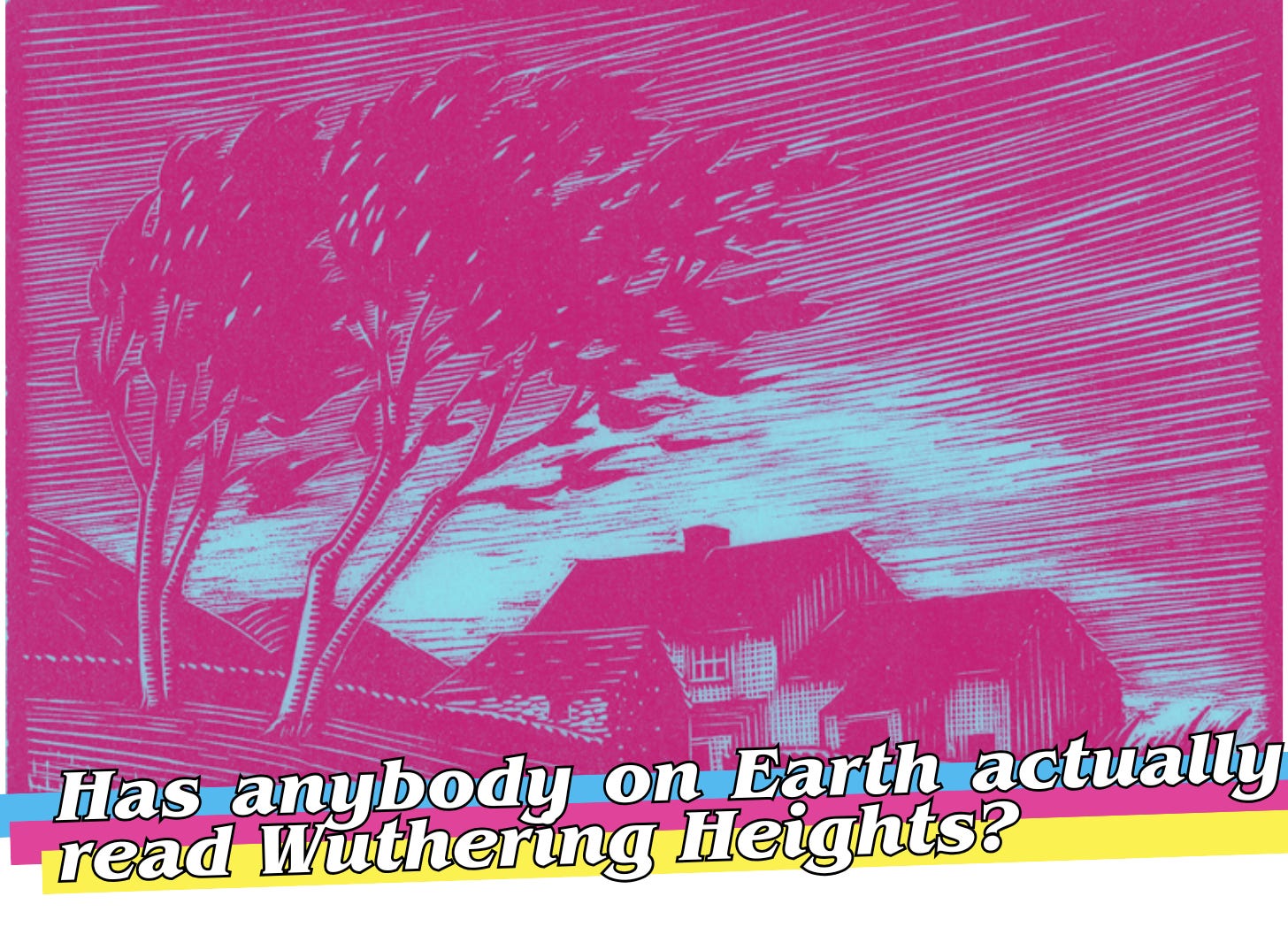
Woodcut by John Greenwood.
My job takes me to strange places. The other week I found myself bouncing along the muddy, unpaved roads of a Punta Gorda suburb in search of faulty wells. East of this suburb stretches the barren patchwork of cowfields that dominates Central Florida. Just to the west, on the other hand, is the kind of Florida you’d imagine seeing on TV in the 1950s, all palm-lined, technicolor-paradise streets.
On the surface, my suburb seems to do all it can to distance itself from sunny opulence. The roads are dirt and pothole-ridden. People ride around on tractors and in big muddy Fords. Most of the lots have some kind of livestock living on them, goats, pigs, even emus. Not enough to count as farming, mind. Enough to think of yourself as a farmer.
The lots are large. On them sit multistory, custom houses, set far back from the road. They’re all gated and fenced, wood, iron, or hedge-over-barbed-wire so tall and solid you can’t see into the property. Gee, don’t they know some of us have to get in there to look at their wells? Many of the gates have signs on them. “BEWARE OF DOG, NO TRESPASSING, YOU HAVE BEEN WARNED.” Multiple gates have copies of a sign proclaiming, “WARNING: ARMED CRAZY REDNECK LIVES HERE” with stencils of handguns, or variations on the theme of “MY HOME SECURITY SYSTEM IS AN ASSAULT RIFLE.” One bears a life-sized cutout of a man pointing a gun at the reader.

Lots of American flags, too. At one house, standing tall on one side of the gate, is a Libertarian flag, and on the other, a blue lives matter flag.
Oh, God, guys… I have to drop the detached reporter act. This shit is so stupid it’s funny. It’s funny that the dudes living in multistory houses a five-minute drive from Sunseeker Resort are so proud to call themselves rednecks. It’s funny to watch them LARPing as ranchers. Buddy, come on.
But sitting there on those unpaved roads, looking up the long, forbidding driveways… I have to think. The lots are so large, the fences so high, the houses so huge they seem like fortresses, there in that little suburb of Punta Gorda. A man’s home is his castle — the sentiment so pervades the atmosphere of the suburb I can almost smell it. I can’t help but think it would take a long time to run from one of these properties on foot, even if you could manage to get over the fence. Not that that’s a metric. But I think on it.
My brown coworker doesn’t come to this neighborhood.
How many of these people homeschool their kids, I wonder? Homeschooling is a big thing in Florida, in the palm-stucco-TV suburbs and in these. Some kids never go to public school, never hear from teachers who think differently than their parents, never get the chance to compare their home lives to those of their peers. I don’t know any of the kids who live here. Only that these are not properties that encourage children to play kickball in the cul-de-sac with their neighbors. This is not signage that bids the extended family, “Welcome in.”
I think Americans, economically-comfortable Americans, have a hard time reckoning with the absolute pervasiveness of child abuse — emotional, physical, sexual — in our society. I mean, the simple acknowledgement of this reality, the pain that exists on the periphery of everything, feels bad. Like finding out there’s a sinkhole beneath your house. Like the coyote running off a cliff, looking down for a moment before he falls. But flinching from that pain, or resenting the people who force your attention to it, does nothing to cure it. Can we at least agree to see what is in front of us?
I see a very tall fence.
What the constant chirping about “Parents’ Rights” seems to miss completely (or to obfuscate, if we decide not to hold ourselves to good-faith interpretations) is that a child’s adult family members, who have near-complete control over them, and upon whom they depend for all survival needs, are far and away the people most likely to hurt and exploit them. We allow parents to dictate what their children learn, where they go, who they know, what women are good for, what we think of “those people,” unquestioned. In all discussions of a child’s wellbeing, the sanctity of the family, the household, is held absolute.
I cannot see through some of these fences. They are designed, signed, to ensure no one sees what goes on behind them. A man’s home is his castle. I hope it is also his wife’s. His children’s. I have absolutely no way to know. I am looking for wells. I am staring at the gate and down the barrel of the cartoon gun.
Anyway, let’s talk about Wuthering Heights.
I. The Spectre of White Heathcliff
First, I need to get the elephant out of the room — I have not watched Emerald Fennell’s movie, and I don’t intend to. Nothing that I’ve heard or seen about this adaptation — “adaptation”? — makes me think that watching it would be a good use of the scant hours I have on Earth1 (Heather Parry’s piece on it includes some great analysis of class and character in the source material, although I disagree with some of her points for reasons that will become clear in a moment).
However, it was debate about the movie that first put Wuthering Heights on my radar. When I saw people raging against Jacob Elordi’s casting as Heathcliff, I was intrigued; I’ve long been interested in portrayals of race in classic literature2. I assumed, however, that perhaps Heathcliff was only described as a bit olive in the book (in the vein of Charlotte Brontë’s Mr. Rochester), or that his race might be a subtle detail missed by most readers. I assumed that people were merely participating in the time-honored tradition of overreacting online.
Good lord, was I wrong!
Having read the book, it’s completely baffling now to see otherwise-good analyses of Wuthering Heights continue to assert that Heathcliff could be white. I mean, I respect ambiguity, and I respect coming at a character from different angles, but… he simply isn’t. He’s not. The book repeatedly slaps you in the face with the fact that he’s not. Indeed, I was quite shocked by how unambiguous Heathcliff’s nonwhiteness is. For example:
In his introductory scene, he’s described as a “dark-skinned gipsy.”
When he is first brought into the Earnshaw family after Mr. Earnshaw picks him up off the street, the man says of him, “it’s as dark almost as if it came from the devil,” and it’s noted that he doesn’t speak English, but instead “some gibberish that nobody could understand.”
Speculating about Heathcliff’s origins, Nelly, a servant and the narrator for the majority of the book, says to him, “Who knows but your father was Emperor of China, and your mother an Indian queen.” Later, another character identifies him as “a little Lascar, or an American or Spanish castaway.”
Heathcliff himself contrasts his appearance to that of Edgar Linton, saying, “I wish I had light hair and a fair skin, and was dressed and behaved as well, and had a chance of being as rich as he will be! […] In other words, I must wish for Edgar Linton’s great blue eyes and even forehead. I do—and that won’t help me to them.”
One of the things that alienates Heathcliff from his son, Linton (names in this book are complicated), is the boy’s lack of resemblance to him (paleness). When Heathcliff sees that he has offended Linton, he says, “Now, don’t wince and colour up! Though it is something to see you have not white blood.”
There are many other examples — Heathcliff’s dark coloring, black eyes, and black hair are constantly referenced, and he’s described as a “gipsy” many times.
The most striking instance in the book relating to Heathcliff’s race, though, is his introduction to the Lintons. In this scene, he and Cathy, still children, are watching the Linton children through a window. When they hear them laughing, the Lintons let their dog out of the house, and it bites Cathy. Heathcliff follows as a servant carries her into the house. The servant instantly assumes he is a thief: “’And there’s a lad here,’ he added, making a clutch at me, ‘who looks an out-and-outer! […] Hold your tongue, you foul-mouthed thief, you! you shall go to the gallows for this. Mr. Linton, sir, don’t lay by your gun.’” Mr. Linton, a magistrate, goes on to say, “Don’t be afraid, it is but a boy—yet the villain scowls so plainly in his face; would it not be a kindness to the country to hang him at once, before he shows his nature in acts as well as features?” (emphasis mine), and his daughter, Isabella, says, “Frightful thing! Put him in the cellar, papa. He’s exactly like the son of the fortune-teller that stole my tame pheasant.”
They do not know who Heathcliff is, or whose family he comes from, or that he was found as an orphan. These comments are based solely upon their first impression. Sure, he and Cathy were spying — but the Lintons’ instant leap to assumptions of criminality and threats of hanging, which they themselves tie explicitly to Heathcliff’s appearance, makes it clear, especially in context of previous descriptions of Heathcliff, that this interaction is colored by his, well, color.
I want to emphasize this again: Would it not be a kindness to the country to hang him at once, before he shows his nature in acts as well as features?
Heathcliff’s race is not incidental, not a passing detail, nor an isolated point of intrigue. It is central to his character, central to his interactions, and central to the thematic underpinnings of the book. The prejudice Heathcliff faces actively transforms him from the stoic, inoffensive boy Mr. Earnshaw brought home to the violent, vengeful patriarch who dominates later years. There is no other word for what Heathcliff faces but racialization; removing the idea of race from all of the above excerpts, and from Heathcliff’s character arc, render them nonsensical. He is othered, scorned, and abused on the basis of his dark features. This is text.
But… it is sort of ambiguous, isn’t it? We never get a clear answer as to Heathcliff’s ethnic origins. Maybe he could be, as many people argue, “Black Irish,” or simply an ordinary black-eyed European, a dark, tempestuous, sexy Mr. Rochester type and nothing more. This is classic British literature, after all. Why are you reading into it? It’s much more likely that all of the characters are white. A British woman back then wouldn’t have any reason to write about a brown man, any reason at all to reckon with hierarchies of race. British people in the 19th century didn’t have any interaction with, say, Indian people.
I’ll stop being an dick. People do make informed demographic arguments; sure, it’s historically plausible for Heathcliff to be Irish. Irish people themselves weren’t always considered White, so he could still face prejudice, historically, even if that would mean he is not a person of color in the modern sense.
Now, I could engage on these terms, and argue that Earnshaw picks Heathcliff up at a port that was used heavily in the slave trade — it’s equally plausible, I could say, that he’s African, or South Asian, or Native American, and none of these are explicitly disproved. What matters to the story’s themes, I could say, is the process of racializion and othering that he undergoes; it does not matter if he would check the Caucasian box on a modern American census — he is racialized, indisputably, within the narrative.
But arguing semantics and historical demographics requires me to concede that Heathcliff is ambiguously white or not-white in the modern sense — and I do not concede that. Because, fundamentally, it requires me to believe that Brontë did not intentionally tell the story she told. It requires me to dismiss all of the excerpts I cited above as meaning nothing in particular, the recurring topic of Heathcliff’s color as speaking to no broader historical realities; it requires me to cut Wuthering Heights off from all possibility of global colonial allegory. Most of all, it requires me to believe that when Brontë describes Heathcliff’s skin as “dark,” she meant something other than what she wrote.
II. Reading What’s On the Page
It seems to me that many of the people writing about Wuthering Heights — in this moment and in the past — have a near-pathological compulsion to reimagine the narrative as catering to their own ideas of what it should or could be about.
This sounds harsh. There is always, of course, a certain degree of subjectivity to any piece of art based upon the ideas that a reader brings to it. However… for instance, here’s an essay arguing that Wuthering Heights is about coal, using a sky-high level of abstraction to link it to Heathcliff’s “prehistorical” outsider status — but explicitly choosing not to consider race. Meanwhile, in order to argue that Wuthering Heights is about race and class disparities, you can just… cite the multiple specific and narratively-relevant instances of race and class disparity.
I mean, there’s a difference between reading into certain aspects of a story — there’s certainly an interesting ecological angle to be explored in Wuthering Heights! — and dismissing one of the central ideas of the text in favor of those analyses.
In Heathcliff as bog creature: racialized ecologies in Wuthering Heights, Emma Soberano writes, “Critics take interest in Heathcliff’s racial ambiguity not for what it tells us about race but for the symbolic register […] I thus propose reading and taking seriously race in Wuthering Heights, not as a symbol but as race.“
I see this issue constantly in the “is it a love story” debate. On the one hand, for anyone to imagine Wuthering Heights as a simple forbidden romance is baffling; it’s really a demoralizing, wretched read3, and I can’t picture anyone thinking it’s appealing as a romance besides perhaps the 14-year-olds reading it for school (and while I have the utmost respect for 14-year-olds’ startling tastes, we must acknowledge that this is not an interpretation for adults).
On the other hand, there’s a strangely holier-than-thou equal-and-opposite crowd who insist that only fools think Wuthering Heights has an aspect of romance at all. Heathcliff is a monstrous villain, obsessive and abusive, and his relationship with Cathy is toxic and codependent from the start. Reading romance in it is insane! This take-haver sometimes goes on to proclaim that the book’s ending, enshrined by the union of cousins Cathy Jr. and Hareton Earnshaw and the death of the infamous Heathcliff, represents a sort of healing from the scars of generational trauma, a return to a right state.
The thing is… that’s… uh… not the story.4
I don’t particularly want to play the Heathcliff redeemer here. He’s a great character, but he totally sucks; he’s abusive to his wife and child, manipulative, myopic. However, I’m kind of forced into that role, because it’s the best jumping-off point for a discussion of the mistakes that I see people make so often in interpreting this text.
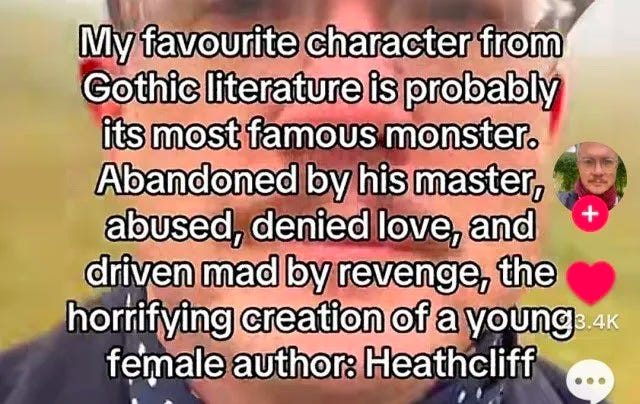
For instance, I’ve been shocked to see, in scholarly and in casual analysis of Wuthering Heights, that it is often taken as a given that Heathcliff commits marital rape against his wife Isabella (the essay by Sobrano that I quoted above does this). To be clear, it’s a distinct possibility; it’s clear as can be their marriage was awful. However, it is at no point made explicit that sexual assault occurred, nor is it even heavily implied. I mean, it’s possible for pregnancy to result from an abusive relationship without out-and-out rape involved — I’ve had friends in this situation! Heathcliff himself even says that, at least at first, “No brutality disgusted her.” Whether their relationship was physically abusive is also somewhat ambiguous; in Nelly’s telling, Isabella, after souring on Heathcliff, heavily implies that it was, while Heathcliff says he has “avoided, up to this period, giving her the slightest right to claim a separation.”
I am not saying that rape was definitively not involved. I think it’s quite… telling… though, that the absolute worst interpretation of Heathcliff’s behavior is the one audiences widely take as a given (…Remind you of any of the scenes I’ve quoted so far?).
This happens constantly. In my opinion it’s related to a key issue certain readings of the text: namely, taking the words of the narrators at face value.
See, Wuthering Heights has a really interesting framing device. There’s the first-person narrator, Lockwood, but the majority of the Earnshaw/Linton story is told to the readers and to Lockwood by Nelly, a gossipy servant. Within Nelly’s narrative, large chunks of the story are told to her by other parties.
Events are not relayed through an all-knowing, detached reporter; instead, most come through double-and-triple layers of unreliable, biased people talking about events long-passed. We cannot be certain at all about what Heathcliff did or didn’t do, how awful Cathy really was as a child, whether parents were cruel or kind — all of the information we receive, except for Lockwood’s firsthand accounts of his own interactions with Heathcliff, is hearsay.
But wait, wait — wasn’t I just saying that people should take descriptions of Heathcliff literally? How can I then go on to argue that readers shouldn’t believe descriptions of events?
The key issue here is intentionality.
For example, the argument that we as an audience are supposed to understand Nelly’s narration as describing events exactly as they happened, to the letter, requires us to assume that Brontë created all of these twisty layers of narration across multiple chapters and took care to emphasize Nelly’s gossipy and judgemental nature just… cuz? As, like, set dressing?
It seems obvious to assume that an author chooses to include details in her work deliberately. But, when it comes to discussion of Wuthering Heights, this assumption does not seem to be operating.
Let’s return to the “is it romantic or not” question. Is Heathcliff an irredeemable monster5? Well, I’m not here to litigate that. However, I have seen multiple people cite a particular instance: Of course he’s irredeemable! He hung his wife’s dog! Some people even say he killed the dog.
Which… A, crucially misses the fact that the dog is not dead. Specifically, Nelly found it “suspended by a handkerchief, and nearly at its last gasp” (not specified to have been hung by the neck) and then “quickly released the animal.” A minute later, it’s running around and barking. Heathcliff himself later brags about hanging it — indeed, as an adult, he has a habit of playing up his own violence and brutality — but, of the many accusations we can level at Heathcliff, “tying a dog up with a handkerchief, maybe or maybe not by the neck” is neither the most definite nor the most severe.
To be clear, I’m not dismissing animal abuse, and this is just one example of Heathcliff’s overall suckage. What I want to draw your attention to, though, is the fact that Brontë chose to specify that the dog did not die. She chose not to make Heathcliff the killer of his wife’s yappy little dog. Sure, maybe he meant to kill it and just didn’t manage to, as many Reddit warriors claim — but that’s a shockingly Watsonian explanation, isn’t it? If he had killed the dog it would be narratively inconsequential, still just another cruelty in his list of cruelties… but he specifically didn’t kill it. If the point is that Heathcliff is just an outright, inhuman villain, why not have him kill the dog?
Why, also, include the scene were Heathcliff catches the infant Hareton after his deranged father drops him from a balcony, saving his life? Hareton grows to love Heathcliff because he saved his life when his own father would have killed him. Brontë does not hesitate to showcase Hindley’s brutality, and in a point-for-point contest of the two characters’ terrible acts, Hindley would surely come out ahead. Even Hareton takes his own casual foray into dog-hanging.
To be honest, I found a different interaction between Heathcliff and animals more memorable than the dog-hanging. Right before he receives the news of Cathy’s death, he stands “leant against an old ash-tree, his hat off, and his hair soaked with the dew that had gathered on the budded branches, and fell pattering round him. He had been standing a long time in that position, for I saw a pair of ousels passing and repassing scarcely three feet from him, busy in building their nest, and regarding his proximity no more than that of a piece of timber.” It’s striking, the way he’s able to blend with nature, the way the birds are at peace near him. The contrasts between Heathcliff’s bursts of aggression and his moments of serenity, between the tolerant boy he was and the angry man he became, exist for a reason. The moments where he is cruel and abrasive, the moments where his actions fall short of that professed cruelty, and the moments where they don’t, are all presented, through many obscuring layers, for our consideration.
We should, y’know, consider them.
Though this isn’t a love story, there is a romance at the heart of it. There is genuine love in the relationship between Heathcliff and Cathy — otherwise, what are we to do with all those heartwrenching laments of one for the other? There is also a real element of fantasy to it; is it not appealing, just a bit, to think of someone being so devoted to you that they scorn all people in favor of you, devote their life to vengeance on those who caged you, and even tried to follow you beyond the grave? As BDM writes in a new piece for The New York Times, “For those whose hearts crave the bleakness of the wilderness, for whom love represents not a pair of doves or a box of chocolates but two hawks stooped to kill, Brontë’s ‘Wuthering Heights’ will remain waiting to be read.”
At the same time as it appeals, it horrifies. Obsession has two sides, the allure, the violence. This is the point.
On that same token, I think one of the most disconcerting claims about Wuthering Heights is that it has a happy ending — that the cycle of abuse ends with the death of Heathcliff and the happy union between Catherine and Hareton. There are many reasons why I disagree with this, but it annoys me most on a pedantic level that people claim the story of the second generation represents a “breaking of the cycle” when 2/3 of the characters are literally named after characters of the previous generation (Catherine and Linton).

 Tiktok failed to load.
Enable 3rd party cookies or use another browser
Are we to assume Brontë just did that for laughs? Just to make it more confusing to talk about the book? Are we to assume that this section of the book being centered upon on an incestuous love triangle between all the offspring of the previous generation simply… doesn’t mean anything? Cousin marriages may have been (debatably) normal “back then,” and incest a staple of Gothic literature — ok, fine — but does that mean we must dismiss it as entirely devoid of thematic significance?
Also, what cycle is apparently broken here? It remains the case that the wealthy heirs of these estates are neglected/abandoned by their parents or orphaned, that they have virtually no contact with outside society, and that they fall in love with each other mostly because there’s no one else around who will express affection for them (Catherine’s father essentially forbids her to venture outside of their estate).
Then, at the apex of Heathcliff’s rise to power, the height of his villainy, when he has control of the estates and all the heirs of the Earnshaws and Lintons under his thumb… he doesn’t do anything. After years of work, of grief and rage and petty torments, he doesn’t have the will to bring whatever his master plan actually was to fruition. In his own words:
“It is a poor conclusion, is it not?” he observed, having brooded a while on the scene he had just witnessed: “an absurd termination to my violent exertions? I get levers and mattocks to demolish the two houses, and train myself to be capable of working like Hercules, and when everything is ready and in my power, I find the will to lift a slate off either roof has vanished! My old enemies have not beaten me; now would be the precise time to revenge myself on their representatives: I could do it; and none could hinder me. But where is the use? I don’t care for striking: I can’t take the trouble to raise my hand! That sounds as if I had been labouring the whole time only to exhibit a fine trait of magnanimity. It is far from being the case: I have lost the faculty of enjoying their destruction, and I am too idle to destroy for nothing.”
If the story was really a cut-and-dry narrative about how there was this one guy who sucked really bad and was evil and he destroyed the happiness of these families, but then he died and it’s okay now :D … why in the world would it end like this, with Heathcliff being simply unable to cause the misery he’d aimed at? Why would he have been such a likeable child, painstakingly shown to be molded into a snarling, vengeful man by the prejudice he faced at every turn?
Also, that story would be BORING. And if Brontë had wanted to write a banal, uncomplicated narrative about an evil guy, I trust she had the skill to do it.
The story we have instead is genius. The way the details all weave together, the webs of implication and half-truths and hypocrisies… it’s an impeccably crafted narrative. Nothing is simple set dressing. The very ground, the moor itself, is woven into a rich thematic tapestry of nature, artifice, and alienation.
What my complaint boils down to is that a lot of the arguments surrounding this text require you to assume that Brontë includes details for no deeper reason than to include them, with no aspiration toward broader political or philosophical themes. At the extreme end of this tendency you have Emerald Fennell’s hetslop movie. However, many critics of the movie do the exact same thing, failing to recognize Heathcliff’s race as thematically important and failing to see anything but toxicity in his relationship with Cathy. Both require you to straight-up ignore huge chunks of the text, a significant portion of its thematic ambitions, and also its complicated narrative structure based on hearsay, hipocrisies, and doublespeak.
Brontë didn’t go through all the trouble of creating this framing device just cuz. She didn’t name Heathcliff’s own son after his rival just cuz, or pair off Catherine and Hareton just cuz. She was capable of recognizing that the things done to certain characters were deplorable even when her narrators did not, and that’s the entire point of the story.
And it seems like no one even notices what a feat she achieved. They’re too busy bickering over whether Heathcliff represents a woman’s bodice-ripper fantasy or not, or whether classic writers can be trusted to have written the words they meant to write.
I mean, good lord. Would it kill you people to believe Brontë knew what she was doing?
III. The Case [for/against] Cathy
“John laughs at me, of course, but one expects that in marriage.”
— Charlotte Perkins Gilman, The Yellow Wallpaper.
If we can agree that the layers of unreliable narrators color the version of the story we receive, then arriving at a “true” judgment of a character’s actions is impossible. We’re forced to puzzle out the broad shapes of what “really” happened from a tangle of multiple characters’ testimonies and judgments.
(Can we take a moment to appreciate how fun this is? Nothing “really” happened at all, but Brontë has created such a sublime shadow-play.)
The only time readers hear from Cathy Earnshaw directly is when Lockwood reads a few pages of her childhood diary. Otherwise, she appears only as narrated by Nelly.
Nelly characterizes Cathy is as a wild and spoiled child, and is rarely charitable in her descriptions. Still, we’re able to get a sense, corroborated by the testimony of Cathy’s diary, of a childhood characterized by repression, isolation, the constant correction (verbal or physical) of any hint of willfulness, and punitive religious instruction.
It seems that Cathy was a feisty and independent child, and unmistakably a landlord’s daughter. To be honest, as someone who has had friends with BPD, Cathy is familiar to me. I don’t want to spend a long time arguing this point — if you know, you know. No, I’m not saying Brontë had a modern diagnosis in mind when writing her. But certain types of people have always existed, and it is reasonable for an author to have described them without having the ideas of modern psychology onhand.
Maybe a pious, stable, obedient girl would have been able to grow up in these circumstances without making quite so many enemies. But, nevertheless, is Cathy wrong for bucking against unreasonable restraints? If people interpret your every action as defiant, regardless of intent, you might reasonably give up trying to please them.
For those who aren’t picking up what I’m putting down, I’ll put it bluntly: Would Nelly, Joseph, and everyone else have disapproved of Cathy’s personality so much if she had been a boy?
Readers of classic literature have this tendency to ideologically roleplay as people of that time. Sometimes this is necessary — you can’t really enjoy The Illiad without sort of buying into the moral code it operates under, nor can you make sense of Moby Dick without taking into account contemporary attitudes about race. However, sometimes I think this goes too far, assuming a uniformity of attitudes among people at a given time and working off of incomplete information about those prevailing attitudes (Clearly Wuthering Heights isn’t about race. People didn’t understand racism back then the way we do now. It’s a product of its time6). Donning the mantle of Victorian sensibilities, readers agree that Cathy’s behavior is inappropriate, and that she is as much a monster as Heathcliff. She’s a flirt and a brat. Clearly the narrative means to condemn her.
But does it condemn her? Do the words written on the page, independent of whatever ideas we readers have about the attitudes of the 1840s, weave a narrative in which Cathy is no more than a moral warning, a spectacle of toxicity whose caprices bring about her own downfall?
Well, clearly my answer isn’t yes, but it’s also not no.
We see the emotional environment in which Cathy and Heathcliff grow up, repressive, punitive, anemic. And in this dreary place, Cathy dares to have spirit. She dares to want things. She commits the cardinal sin of wanting friendship, wanting adventure, wanting Heathcliff. She and Heathcliff, constantly subject to vicious racism (”a kindness to the country to hang him at once”), have the audacity to gravitate toward each other… being literally the only two kids around.
To be honest, I can’t fathom reading this book and thinking it’s as simple as that Cathy and Heathcliff were just bad people, and through their bad natures ruined a peaceful slice of life. It’s the strictures of class, whiteness, and patriarchy that leeched the life out of them.
Yes, I’m onto some SJW shit now. But you’ve made it this far — you’re buckled in, and you’ll go where I damn well please to take you.
My sympathy for Cathy is complicated, because, in the end, she caves. She makes the choice to marry Edgar Linton, the man whom this propriety she’s railed against her whole life dictates she should marry, because to do otherwise would be to renounce her status entirely. She caves to the pressure to be the white, rich wife of a white, rich man, instead of following her human impulses, her soul, towards Heathcliff. Even though she’s railed against the dictates of society her entire life, when the moment comes to abandon them, she doesn’t. She chooses Edgar Linton, and it’s the wound that bleeds across the remainder of the story.
I don’t see a lot of discussion about the precise manner of Cathy’s death. Which is surprising, because it’s one of the most horrific things in the book.
People die of a broken heart quite often in classic literature. Coupled with childbirth, that’s sort of what happens to Cathy. It could be easy to call it melodrama, weakness, and Cathy is self-aware about that. She says, “Supposing at twelve years old I had been wrenched from the Heights, and every early association […] and been converted at a stroke into Mrs. Linton, the lady of Thrushcross Grange, and the wife of a stranger: an exile, and outcast, thenceforth, from what had been my world.[…] Oh, I’m burning! I wish I were out of doors! I wish I were a girl again, half savage and hardy, and free; and laughing at injuries, not maddening under them! Why am I so changed?”
You can claim Cathy deserved what she got, either because of her wild and selfish nature or her choice to marry Linton. But the account we receive of what happened to her is, on its face, horrifying.
Nelly doesn’t condemn the way Cathy’s psychological deterioration is handled. Indeed, she’s annoyed with Cathy to the last. However, looking at the literal events she lays out, what I see is: A mentally unstable woman is locked in a room for months following a nervous breakdown, starving herself, suicidal, miserable, and out of touch with reality7. Eventually, she weakens herself so much that she wastes away and then dies in childbirth.
I mean… that’s rest cure shit!
After the horror of Cathy’s death, Linton is distant from their daughter for a few days, but then comes to love her. And… keeps her isolated for years, forbidding her to go beyond the Grange or explore the moors. Of course she falls in love with her cousin as soon as she meets him. He’s the only boy she’s met!
If we don’t pretend that people writing in the 1800s understood nothing about empathy, and nothing about the effects of isolation, how can we possibly view this narrative as a simple “don’t be like these people” story, or Cathy and Heathcliff as characters meant only for scorn?
Might we instead have to acknowledge, maybe, that Heathcliff was right to be a little mad?
Brontë wrote sympathetic characters. We are invited to resonate with Cathy’s free spirit, with Heathcliff’s otherness. We are invited to suffer alongside them. We are invited to see beauty in their love for each other. Without that beauty, without that sympathy, there would be no tragedy, because there would be nothing lost.
And the point is to show us what’s lost.
IV. Place and Alienation
As an ecologist, something that fascinates me in fiction is when nature fills the role of divinity. It happens in Jeff VanderMeer’s Annihilation and even in the video game Disco Elysium8. Characters’ relationships to the ecosystem represent separation from or submission to the whole of life; the closest they can come to apotheosis is by surrendering themselves to something great and unknowable.
The moors take on an important role in Wuthering Heights. They are more than a frame, do more than provide the stark, distinctive atmosphere. Nature reaches into the narrative, enveloping Heathcliff at the news of Cathy’s death, scaffolding the final line: “I lingered round them, under that benign sky: watched the moths fluttering among the heath and harebells, listened to the soft wind breathing through the grass, and wondered how any one could ever imagine unquiet slumbers for the sleepers in that quiet earth.”
In childhood, Heathcliff and Cathy ramble freely out across the moors. On her deathbed, Cathy cries, “I wish I were out of doors!” and flings open the window of her room to feel the icy air. She says, “I’m tired of being enclosed here. I’m wearying to escape into that glorious world, and to be always there: not seeing it dimly through tears, and yearning for it through the walls of an aching heart: but really with it, and in it.”
There are the moors, and Cathy’s spirit; then, there are the interiors of the great houses, Mrs. Linton, separate from all she was and all that was her soul.
She dreams, “Heaven did not seem to be my home; and I broke my heart with weeping to come back to earth; and the angels were so angry that they flung me out into the middle of the heath on the top of Wuthering Heights; where I woke sobbing for joy.”
She and Heathcliff were separated from nature, that of the ecosystem and of their own humanity, in order to live wanting, miserable lives in fine houses and then die. If there is a happy ending to be had, the state of the Earnshaws and Lintons remaining has nothing to do with it. It is the return of Cathy and Heathcliff to the moors.
The central matter of Wuthering Heights is alienation — by society, from each other, from nature. I do not think anything about these ideas has to be changed or simplified in order to be highly relevant to audiences in the modern day.
V. Conclusions
I did not expect Wuthering Heights to break my heart. I certainly did not expect it to be what it was. It is a complicated, tragic, and, indeed, very political tapestry. It is as sharp in its discussions of class, race, and patriarchy as it is in its explorations of desire and obsession. You can get as mad as you want at me about making it political, but this stuff is there. Ignoring it does a disservice to the book and to its author.
It is egregious, and misses the point, not to understand Heathcliff as man of color. It renders inert what is otherwise a live current that runs throughout Wuthering Heights. This book is predicated on his otherness. It’s predicated on, more than that, the sublimation of diversity – meaning here simply “difference” — by the social power of wealth and whiteness. Removing that dimension adds nothing and takes so much away.
This is such a bleak, frustrating story because all of the suffering in it comes from pointless exclusion and from the doctrine of how people should be. None of this had to happen. It’s not that Heathcliff is a demon and Cathy is a bitch. They are human. They’re not necessarily good people. But the core of the narrative is the making of these people into monsters, a ghost and a devil, by crushing them into a society that cannot accommodate them.
That’s the level I have to engage with this book on. Because, otherwise, I cannot grasp any substance in it. I do not understand how people come to love Wuthering Heights without seeing it as political, without recognizing it for the masterful portrayal it is of the suffocation of humanity within the strictures of class.
Suffocation — in service of what? In service of keeping the house. Respectability — but who’s there to respect this? The countryside is empty, the houses barely staffed. The life of a wealthy landlord seems to be a miserable, empty, personless place that eats and destroys any spark of humanity that comes into it. The whole narrative is about people betraying and destroying themselves — and their children — for nothing. Cathy chooses Edgar, Edgar keeps their daughter confined, Heathcliff makes his fortune only to come back to the place where he began; they make themselves miserable only in order to maintain their miserable lives.
I feel like this remains as relevant today as it was in the 19th century. The rich are miserable, the people living in accordance with “traditional values” are defensive and repressed, and yet they are all compelled to maintain such lives. For what?
In all of Wuthering Heights, nobody really takes a step back and thinks, like, why is it so wrong for this girl to love this boy? Why is it so wrong for him to be here? Why is it wrong for her to have a spirit, to roam, to want?
The treatment Heathcliff and Cathy face is prima facie horrible. The fact that Heathcliff turns into such a terrible tyrant does not negate the abuse. Indeed, oppression often makes worse people of its victims — as for any animal, repeated violence will make a person unpleasant, paranoid, cornered, and bitey. Sometimes everybody being mean to you will render you indisposed to be kind in return. Understanding this is, I think, crucial to actually helping people who have been oppressed. Heathcliff’s victimhood in no way makes up for the things that he does to this second generation, especially his own son, but this context is what makes his later actions coherent with the broader themes of the book. Something set the rock rolling.
In the end, Heathcliff became exactly what everybody always told him he was. Yet… really, not even as demonic as that. He never killed anyone. He never drove a knife through Linton’s chest (and I would’ve been tempted to). He didn’t end up ruining either of the families he’d intended to ruin. He created oppressive, draining environments for the people in his care, and yet that was exactly what was done to him. When he was a child, they said they should hang him before he grew into his features. Can you imagine? They told him he was not human, and so of course he did not act humanely.
This is the tragedy.
It is the essence of my understanding of Heathcliff. A young boy was thrown into a society in which the basic operating principle is the maintenance of wealthy, white, patriarchal power, and the machine crunched him up and spit him out as it was designed to do. When he returns to wreak havoc on that society, he is not some outside threatening force, but its own natural result. He is the shadow of white upper-class society. We are invited to analyze what created him9.
In the end, the system wins out. The same patterns repeat. We’re left with the children of the same people, with the same names, served by the same servants, living in the same houses. The disruption is over; the blood of the outsider has been excised from the line. The tenants pay their rents, the white man loves the white woman in the castle on the hill, and this world carries on in its peaceful, incestuous tradition.
VI.
I idle in a driveway of the Florida suburb, on the land that less than a century ago was swamp. The flag hangs limp above the mechanized gate, blue stripe bright on black. I crane and stretch to see through the bars of the fence, to see the house, to see the place where the water swells from deep underground.
BTW — the audiobook of Wuthering Heights is free on Libby, and you can access the full text online here. In case it’s not clear, I loved this book, and I highly recommend checking it out.
I have high standards for adaptations. Some of my favorite pieces of media have been adaptations, prequels, reimaginings, etc — the shows I recommend most often are Black Sails, Interview with the Vampire (2022), and A League of Their Own (2022), all of which fall into these categories — so I believe strongly in the potential of adaptations to be great… which means I tend to rampage when they aren’t.
A thought first sparked by The Count of Monte Cristo and fed by Moby Dick, both of which are surprisingly diverse.
As a lover of miserable art, these are the highest compliments I can give.
I agree with both the Tumblr posts I linked in this section. I contain multitudes.
A woman at my book club pissed me off by saying she hated Wuthering Heights because she was “tired of reading books about terrible men.” Lady, that is so far from the point you may as well be past the Kuiper belt.
I think it’s relevant that Charlotte Brontë’s Jane Eyre is also centrally concerned with how the rules of class and polite society result in the suppression of the human spirit — and has some complicated ideas about race.
In the original text of this essay, I said, “While she’s in this unstable state, her husband gets her pregnant.” I’ve since been told that I got the timeline mixed up, and she’s pregnant before she’s put into full lockdown. I do, however, remember her being noticeably unstable even before things really broke bad, when Edgar would have impregnated her. I remain rather dubious about the ethics of their relationship.
I intend to write a full essay about this concept at some point in the future.
We could wonder if Brontë’s use of a vengeful man of color as a tool to critique white upper-class society is racist itself… but most people are still shooting for White Heathcliff, so we might not be ready for that debate until 3026.