


[Introductory note by the author and translator: The good peoples of Dead Horse Press asked me to collaborate with them, and thus I decided to contribute an essay of my making. This one I originally wrote as part of my work as a student activist in Argentina, for an as of yet unpublished pamphlet-fanzine. It references the current political situation in Argentina, and for further effect the reader should imagine they are argentine while reading it. If they already are, no further steps are needed.
This essay deals with a variety of my reflections on my work organizing, both good and bad.]
There’s a common sympathetic criticism of the left: that leftist ideas are too complicated for the average person to understand and accept. How can we expect a lifelong worker to grasp concepts like “financial capital” or “commodity fetishism”? Are we sociopaths or something?
This is also linked to an (understandable) anti-intellectual sentiment (against academics, members of the liberal professions—in short, those primarily engaged in intellectual rather than manual labor) coming from the “common people.” This sentiment arises from the fact that intellectual workers are traditionally a sector of the petty bourgeoisie, which privileges them over the proletariat engaged in manual labor (i.e., the contradiction between intellectual and manual labor). Historically, manual labor has always been subordinate to intellectual labor; the ancient Greeks despised all manual work as the work of slaves, and this legacy was adopted by later European societies. This, coupled with a “banking” education system designed to suppress any kind of critical thinking, often leads to distrust of intellectuals.
The response from some sectors and organizations on the left basically consists of dumbing down ourselves and our objectives.1 They say: let’s simplify our ideas, abandon theoretical work and focus solely on mass work, and attack intellectuals. In short, they embrace anti-intellectualism.
This line is anti-democratic and authoritarian. It disguises itself as populist, but it’s the bureaucrats’ line.This is because it leads to a series of strategic errors.
Being an author based in Argentina, I will address some matters pertaining specifically for work in Argentina.
First, in Argentina, people don’t need to be told they should resist. In 2001, ordinary people literally brought down a government. In 2018, millions mobilized for abortion rights, and since Milei took office, there have been thousands of protests. We don’t live in Chile, where the working class is completely subjugated, or in the United States, where people don’t protest because a large sector of the population are labour aristocrats. People don’t need some activist riding a white horse to tell them they have to fight.
Another distinctive feature of our country is that teachers (though originally a segment of the petty bourgeoisie) and students are proletarianized sectors, which is not the case in all countries. We can see this in the massive scale of the demand for public education. By participating in anti-intellectualism, we risk alienating a potential base of support based on prejudice. Because having a general hostility toward intellectual work is a prejudice, even if it has some basis in reality, and a prejudice cannot guide policy.
What’s needed is to convince people (of their own volition) that our ideas are good. There’s no easy way to achieve this, so it’s not as popular as treating workers as if they were literally mentally challenged.
Second point: If we can’t even achieve the minimum level of people understanding our ideas, how are we going to achieve our more ambitious goals of establishing a world economy not run on imperialist plunder and pillage? Goals that, of course, we cannot achieve without popular support.
We must be able to discuss and communicate our ideas effectively—in other words, to engage in dialogue. Ultimately, discussion only frightens us if we are unsure of our own opinions and our ability to defend them. If you can argue properly, there’s no need to fear dialogue. And if you can’t argue properly, you need to research and develop your ideas further until you can.
Third, the complexity of our ideas is not a problem, it is an advantage. Let me explain.
Most existing ideologies have been very simplistic. What is nationalism? The idea that one is a member of a nation and deserves recognition. This is very simplistic, and yet nationalism is the most successful ideology of the modern era. What is Catholic doctrine based on? That the Bible contains divine truth. And yet it has guided European society.
And why are anti-imperialist and socialist ideas so complex? Because they are an attempt to create a knowledge of the whole; they are a guide to transforming the entire world.
Yes, this is difficult to learn, but nothing worthwhile in life is easy. Again,this is the first difficulty that foreshadows all the other difficulties of changing the world. We shouldn’t be afraid of learning and of striving to learn.
Let’s return to some more concrete issues and some difficulties of political organization.
The libertarian movement in Argentina has a peculiarity: It is made up of people who mostly have no knowledge of political theory (there are no libertarian reading groups, no economic seminars on deregulation), but at the same time they claim to be believers in the ideology of anarcho-capitalism, that is, they make a certain appeal to theory.
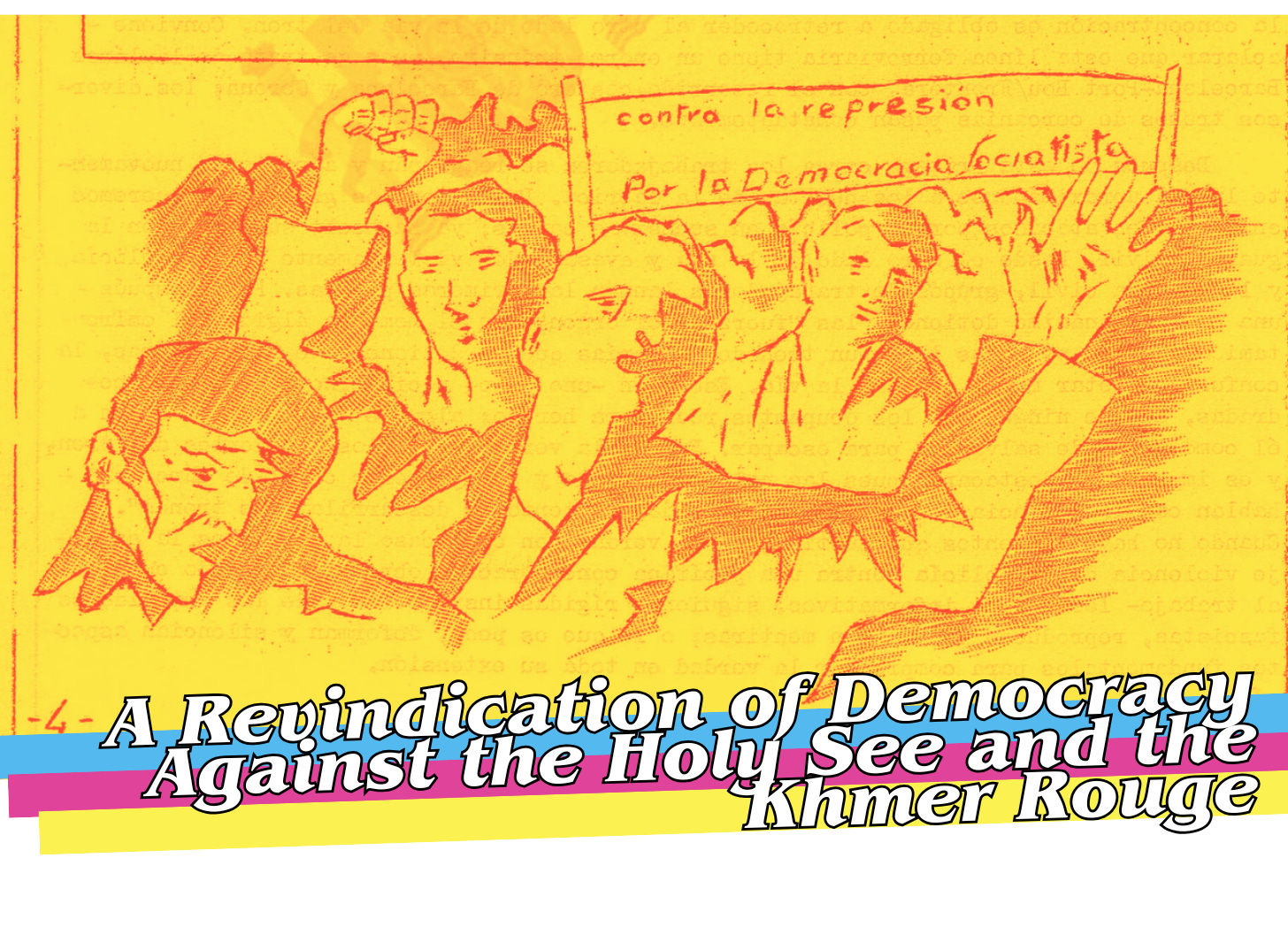
The combination of this level of fanaticism with this level of ignorance turns them into a modern-day Khmer Rouge (who were the backbone of Pol Pot’s regime that killed millions in Cambodia and persecuted intellectuals): extremely violent people (though thankfully they haven’t committed genocide) ideologically driven by a cause they barely understand and who detest intellectuals (we can see as an example the numerous attacks on culture and education carried out by libertarian militants). Fortunately, they are the hard core of Milei’s support, rather than the majority of the population.
What I want to raise is, if we create a political project that doesn’t value knowledge and theory, are we creating left-wing mileists? Is that something desirable?
If our enemies reject theory, knowledge, and culture, we must take up those banners, not stoop to their level.
We also have another potential internal problem, the Holy See, the curia.
During the height of the Catholic Church, European society was (theoretically) divided into three orders: nobles, priests, and peasants. The nobles waged war, the peasants farmed, and the priests prayed—that is, they were thinkers. This represented a rather crude form of the social division of labor and the subjugation of intellectual and manual labor.
The core of Catholic ideology was made up by the Holy Scriptures, which could only be interpreted by theologians. Monks spent their lives copying these scriptures, but they were not allowed to interpret them.
What am I getting at? That we must be careful within our own organizations not to neglect theoretical education to avoid creating a situation where only a very select group has the right to think and reflect.
We must recover the ideas of Paulo Freire, who considered that revolutionary leadership should be in a constant process of educating the masses in order to raise their consciousness (Pedagogy of the Oppressed, page 69):
“A revolutionary leadership must accordingly practice co-intentional education. Teachers and students (leadership and people), co-intent on reality, are both Subjects, not only in the task of unveiling that reality, and thereby coming to know it critically, but in the task of re-creating that knowledge. As they attain this knowledge of reality through common reflection and action, they discover themselves as its permanent re-creators. In this way, the presence of the oppressed in the struggle for their liberation will be what it should be: not pseudo-participation, but committed involvement.”
And a revolutionary leader must keep in mind the idea of being able to pass on their position, of having someone else take their place; we cannot have leaders in immutable positions. Our goal should be that every member of the masses has a real possibility of reaching leadership, achieving a socialization of power. And knowledge is yet another form of power.
Therefore, we must give every member the right to express their opinion, the right to give their own interpretations of ideas, to disagree.
In conclusion, I can say that the central argument of this text is the idea that theoretical development and free discussion are key to emancipatory policies and they should not be neglected.
If you liked this post, you’ll love Santi’s substack:
And ours too, of course:
I was once told, in all seriousness, the story of how the leaders of a certain workers' newspaper were thinking of designing it to be mostly images instead of text, like a kids´ magazine.

if a right is a thing that is given it is also a thing that can be taken away. those of us that are "literally mentally challenged" percieve, reflect, think. consciousness is inalienable. images can be really effective at conveying complex ideas- especially photographs of complex realities. "The idea that one is a member of a nation and deserves recognition" is complicated as all fuck, the details are only obscured by the shorthand of language- what is a nation? what does recognition mean? who recognizes? those monks have been arguing since before christ about the meaning of "divine truth". what separates catholic doctrine from every other christianity? what does guiding society mean? im sorry, im an anarchist,* its true that it's easier to deconstruct a statement argument society than it is to offer a sound alternative. ive only ever had more questions than answers.
genuine thanks for the phrase "labour aristocrats" and accompanying glimpse of outside perspective.
stay safe, stay dangerous, good luck
* we do have reading groups, here, when possible. not a capitalist tho.