

Solomon, the endless, and knots
Infectious art motifs.

When studying art and material culture, odds are you will not know the significance of what you’re looking at on first viewing. Not only will you lack context, details will simply pass you by. Many times, images and items I have collected will have information I only understand after a paper I’ve read or a similar item in another context makes me look at them again with fresh eyes. It may be the commonality of blue and depictions of clothes from a certain era, the texture of cloth in photos, whether or not I can glimpse pant cuffs under a man’s galabeya, or patterns on certain objects and where they or the technology to make them came from.
What we are concerned with today is a similarity between certain variations on Solomon’s knot and the dharmaic endless knot, and how these appear mainly in Medieval Egyptian material culture. We are also concerned with something far beyond that; the symbolism of these knots, how this bears out in reality, and the ramifications of such similarities.
The main variation of Solomon’s knot is a pair of elongated loops interlaced with each other at right angles. The more interesting one also has a diamond or a 4 pointed star woven around the central meeting point. While the first version of Solomon’s knot shows up in Byzantine and Coptic art, the second to my knowledge only turns up in Egypt possibly during the Ayyubid and Fatimid eras, and is not quite common until the Mamluk Sultanate. The two likely oldest examples I have of this also notably include terminating loops and diamonds attached to the points of the center diamond.
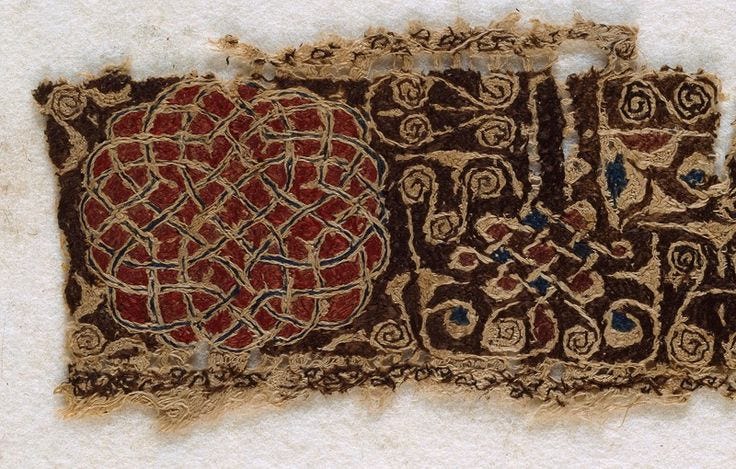
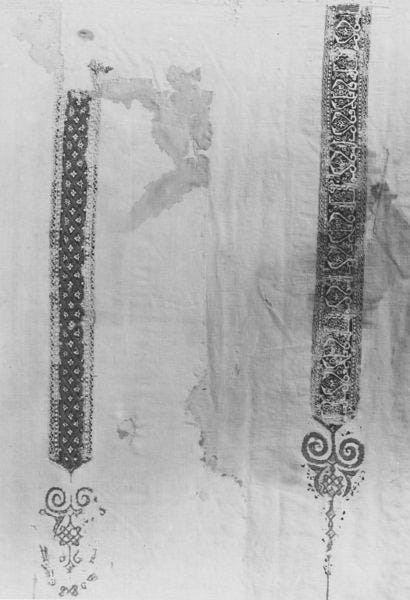
The endless knot, on the other hand, is likely older. Its most common variation is a true knot (Solomon’s knot is not a true knot), basically meaning it is made of a single unbroken line forming a connected shape. It is associated with dharmic religions and traditions influenced by them, and has various assigned meetings. One of these is that it represents entwined wisdom and compassion, interestingly qualities also associated with King Solomon. However, certain variations of the endless knot aren’t true knots. In fact, they are almost exactly the same as the second kind of Solomon’s knot, but 4 to 8 points will have terminating diamonds or loops attached. Further, the first kind of endless knot but lacking the terminating loops appears in Medieval Egyptian art as well! To briefly step outside of our scope, a contemporary medieval Iranian platter has the first endless knot in its full glory.
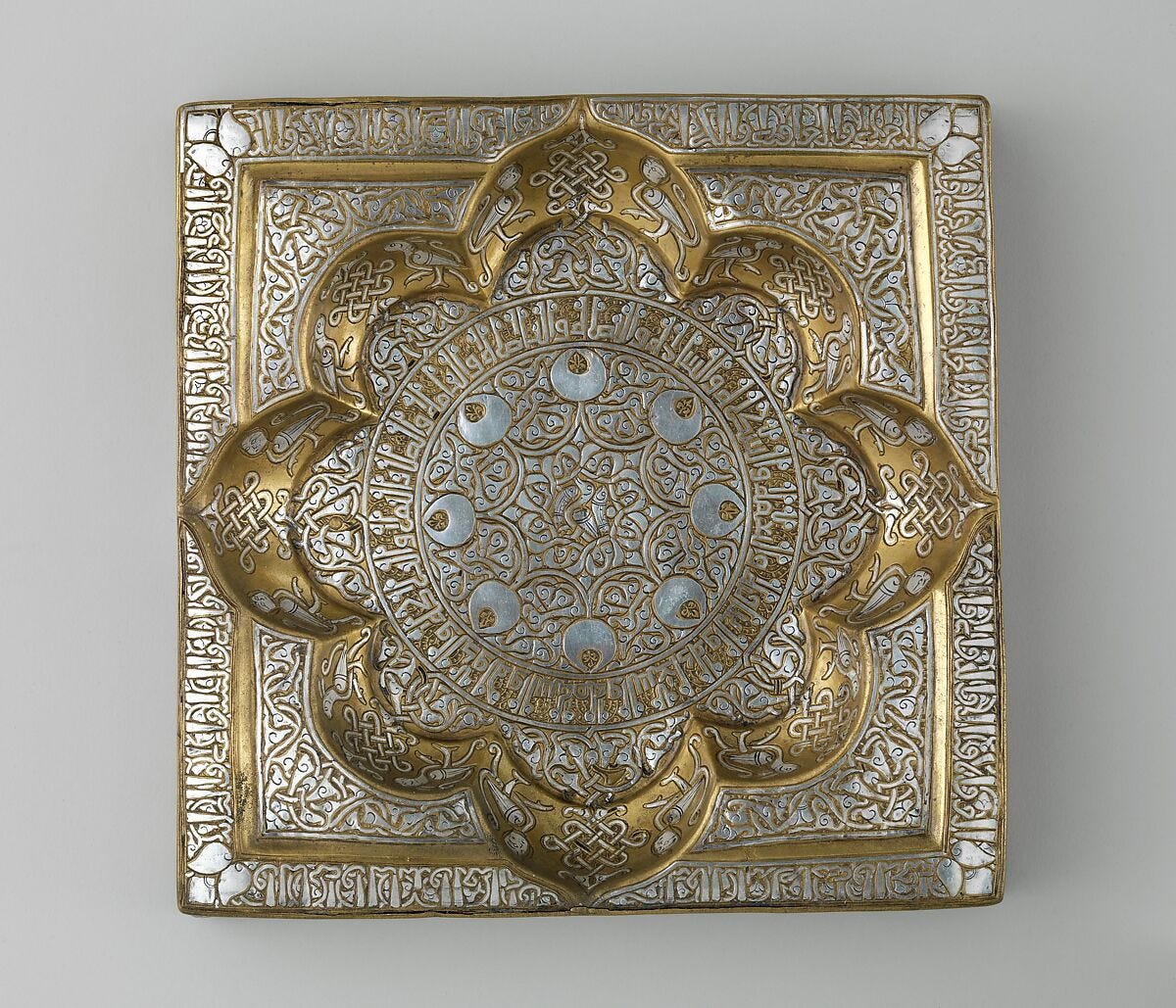
Now, two things looking alike doesn’t mean they’re related. Similar symbols may arise because the material they appear on has limits that encourage certain shapes to be formed. We will get into this more later. However, in the Egyptian and Iranian cases it is also important to keep two things in mind: Trade networks are really vast, and another meaning of the endless knot is the emptiness of all things and dependent origination. In short, everything is connected, and everything comes from something else.
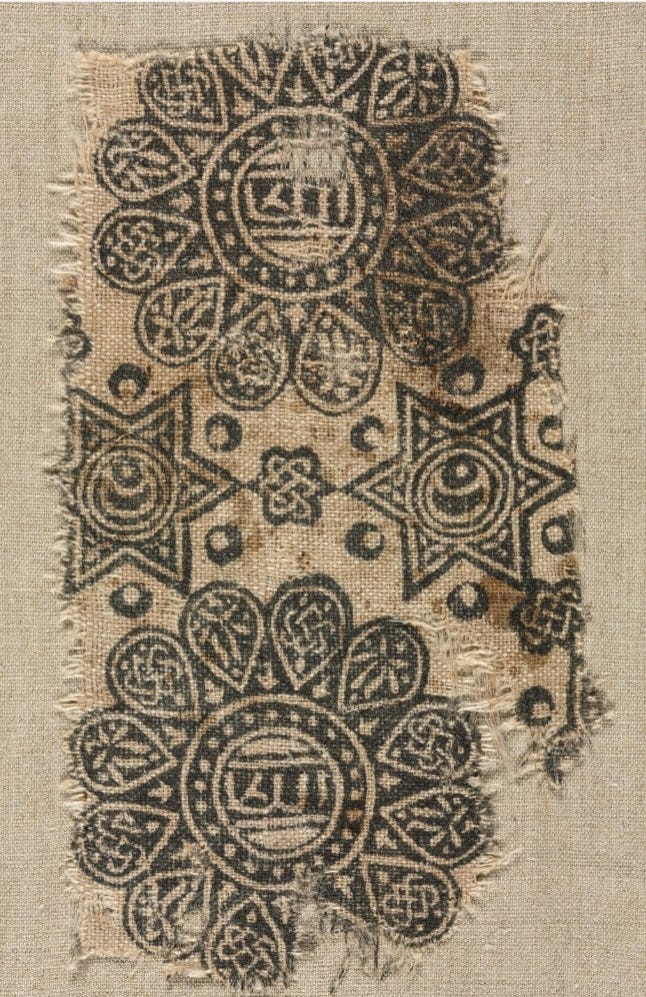
As I briefly mentioned in my article on the qaba, Medieval Egypt had significant Mongolian influence. Not only was the qaba adopted, but Mongolian fashion likely influenced certain hat styles. While the outright invasion of Egypt was repelled, Central Asians did have certain positions of power in the latter half of the Mamluk Sultanate. In Iran, an area that was conquered by the Mongolians, and as a result, has much more obvious Mongolian and Chinese influences in the Medieval era, we again find the endless knot, however, this is not the only vector of influence. Medieval Egypt also traded textiles from China, notably silk, and in return traded locally produced textiles to other countries, often adopting the aesthetics and motifs from them1. Block printing technology may have also traveled along trade routes from China to Egypt2. One of our textile examples of Egyptian knots is a domestically produced block print that also includes lotus and medallion motifs also seen on Indian and Chinese textiles. Medieval Egypt also imported a large quantity of block printed textiles from India that similarly could have had endless knot patterns, though I have not yet found a textile from the period that has one.
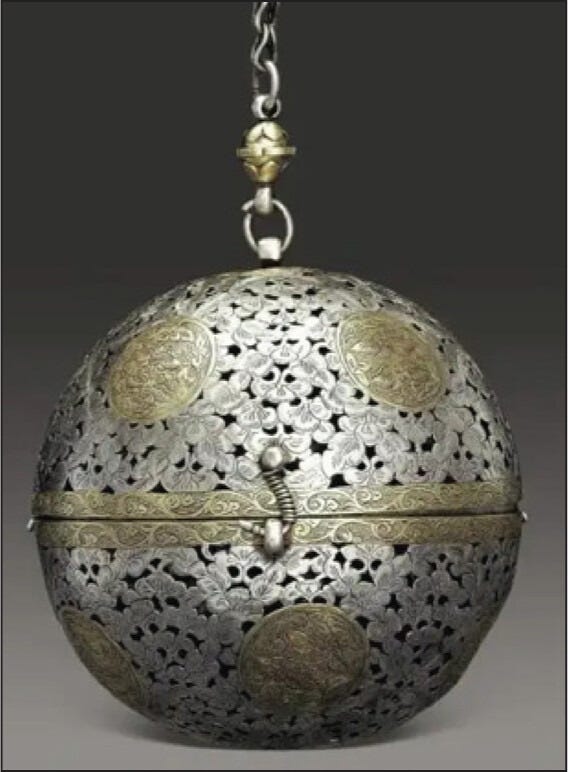
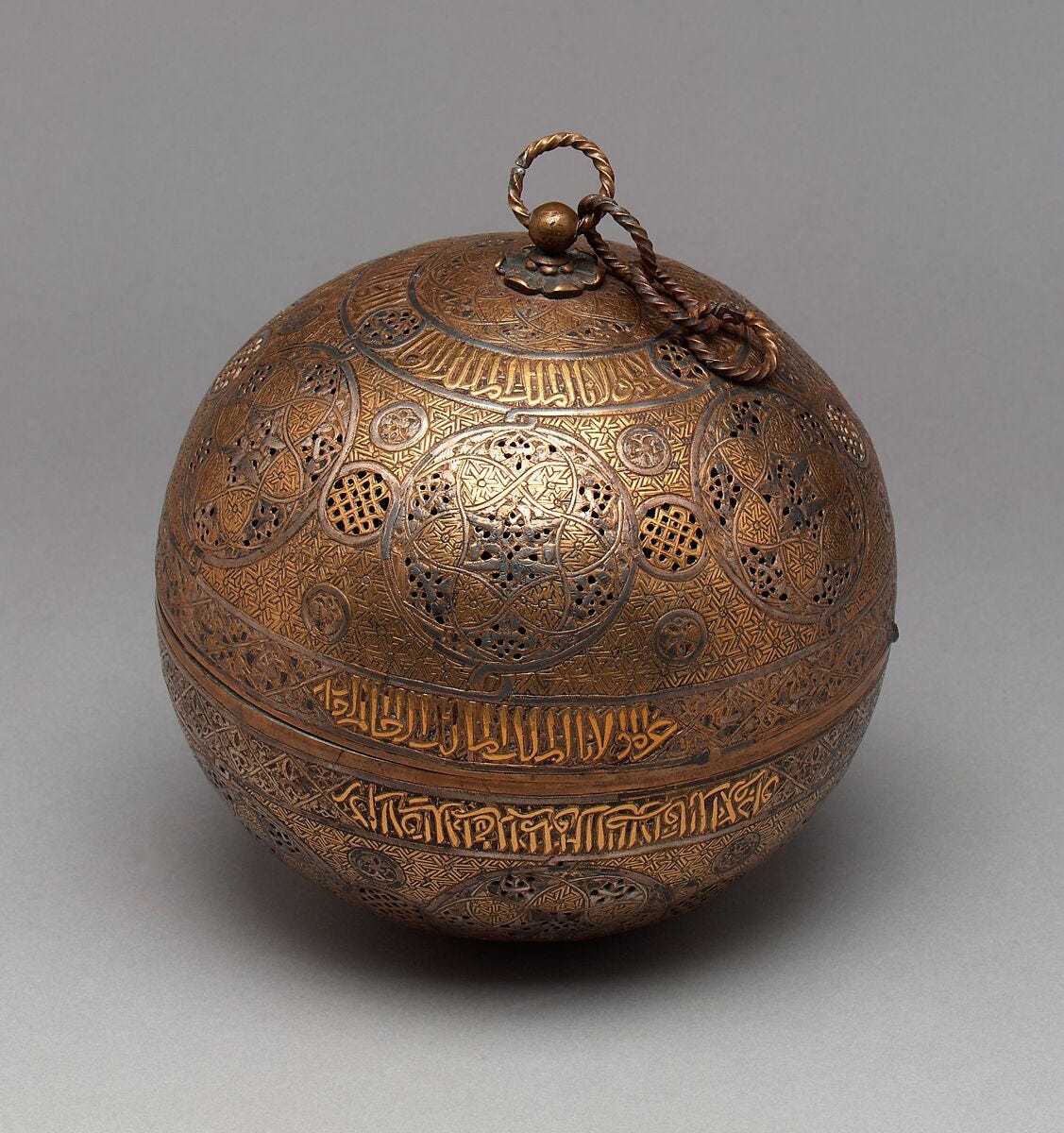
The picture expands further when we look at the metal objects with our knots. While these include boxes and platters, they also include hand warmers/incense burners with a gyroscope mechanism, enabling one to place a flat pan of coals inside a sphere without them spilling or directly touching the shell, which could have caused them to possibly burn someone’s hands. There’s strong evidence suggesting this mechanism and use of it was invented in Tang Dynasty China, meaning domestic manufacture of such items in Egypt likely came from detailed study of Chinese examples that were imported. This could have included the decoration, and the replication of certain motifs into takfeet designs on on hand warmers that may have led to adoption on other takfeet objects. The spherical incense burner also had Buddhist associations. Incense itself was very important in Buddhist practice, and shaped a lot of Chinese thought about scent. These round incense burners were both used in monasteries as ritual objects and mentioned as suitable places to store Buddhist talismans. The use of gold and silver may also come from a Buddhist preference for these materials in ritual objects. Some of the extant Chinese examples also have Buddhist decorations. This makes it likely, in my mind, that imported examples could have had endless knot patterns as a decoration.
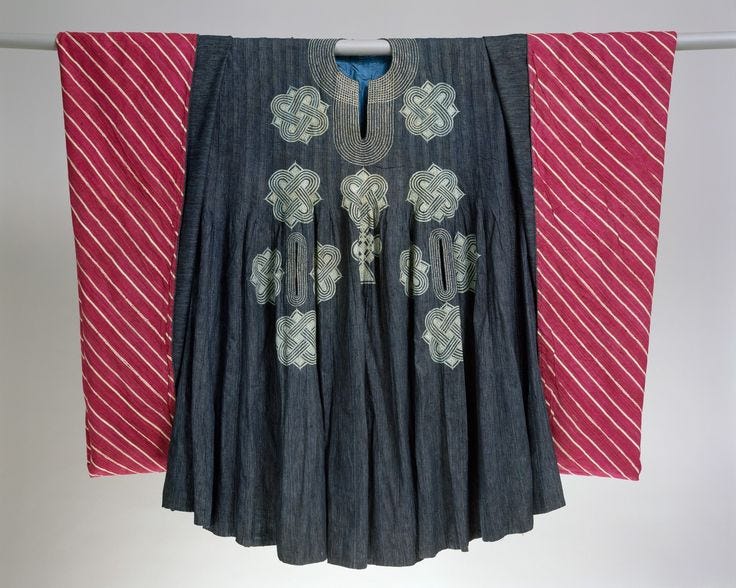
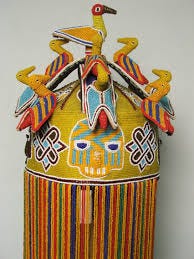
It is also worth noting that this style of knotwork and pattern also shows up in other parts of Africa; this specific variation of the Solomon’s knot, or at least similar patterns, shows up pretty often in West African dress. As I have covered before, the textile trade between West Africa and countries on Africa’s Mediterranean coast was extensive and sometimes led to the adoption of certain motifs and garments into one region or another. Unfortunately I am less well versed in West African textiles, and to my understanding it is often harder to trace their history due to a combination of environmental factors, lack of research funding, and lack of institutional access. Another angle of the adoption of this pattern in medieval Egypt could very well be West African influence, perhaps with both West African and South/Central/East Asian art influences being introduced simultaneously while bearing a similar pattern.
I am hesitant to suggest that the pattern was transmitted to West Africa from Egypt after Asian influence for two reasons: one, there is limited evidence to suggest that this occurred due to the aforementioned research difficulties and how distant the contact would be (though this is not impossible), and two, when it comes to majority Black African countries people are eager to claim that certain technologies and artistic motifs came from outside Africa, due to underlying Afrophobia. It is perfectly possible that this pattern arose in West Africa as a form of convergent evolution from different local processes: while everything is connected and not truly independent, as I mentioned before, artistic material constraints can lead to the creation of similar symbols. For example, if the basic Solomon’s knot is drawn in a square, one can end up with a shape somewhat similar to the knot that appears in both the Solomon’s knot variation and the endless knot variation. It is notable to me that the West African knot usually does not have the diamond as an interlaced shape, but as a shape shown through solid segments of color, similar to how one would fill in the background of a small piece of embroidery with a contrast color. In fact, such a background or frame shape does appear on some Solomon’s knot mosaics from Europe, though typically as a large border encompassing the knot; the Egyptian knots we are concerned with always feature the diamond as an interlaced part of the knot. While the latter could evolve from the former, I believe if that occurred we would see examples of the former before it was altered to suit local tastes. It is also notable to me that I have never seen terminal loops or diamonds on West African Solomon’s knots.
In Nigeria, the symbol is sometimes called the “northern knot”, and can represent the unity in diversity of the northern states of Nigeria. Some people affiliated with Hausa communities believe the symbol may have come from other Christian symbols, or is an adaptation of the hexagram used by some Jews. Of this I am doubtful. While Jewish communities have existed in the Sahel and Saharan regions and are criminally underresearched (with the mere mention of them being dismissed as fantastical due to the use and abuse of this idea by bunk racial theory and a prejudice against Black people), there is limited evidence to support this beyond appearance. The hexagram was not a popular Jewish symbol in ancient times, only becoming an easy symbol of Judaism recently. It was adopted at first by the Jews of Prague as a localized symbol of Judaism in the 1600s- it is only in the 1800s that Jews across Europe began using it as a specifically Jewish symbol, and even then some Jews, such as Jacob Reifman, denounced it as a “stranger’s” motif. In truth, it is not fully strange, yet it is also not particularly Jewish. Before the mass adoption of the hexagram as the “Star of David”, it was primarily an amuletic symbol, often called the “Seal of Solomon”. It was initially popularized under this name by Muslims (who used the term to refer to 7 symbols believed to have ritual power over evil spirits) before being adopted by Christians and Jews in the Middle Ages. The reason it was adopted was, in large part, a post-Emancipation desire for Jews to have a symbol similar to the cross; why the menorah wasn’t enough to serve this purpose, I can’t say. This caused many 19th century Jewish institutions to stamp the hexagram all over their stationery, books, and buildings. Not long after, two things solidified this association, both great evils; Nazi usage of the symbol to humiliate Jews, and Zionist adoption of it as a rallying cry to colonial assimilation. While the scholar Gershom Scholem argues that the “emptiness” of the symbol aided its adoption by Zionism as it had no real religious meaning for most Jews, I take a slightly different position. The post-Empancipation desire to be like Christians is what furthered the use of the symbol, for a major part of Zionism is the project to twist and reform Judaism in the image of Christian European nation states3.
There is evidence of Jewish influence on West African material culture, however. African thinkers, particularly the Yoruba, have associated the symbol with many meanings, such as royalty, the interconnectedness of humans and the divine, but one meaning is interdependence, which is similar to the Buddhist symbolism noted earlier. In communities that celebrate Kwanzaa, it also is used to represent the value of umoja, unity.
Knots are inherently ways of linking together cord, usually multiple cords at once. They reinforce themselves without outside aid. From Northern Nigerian political adoption of the symbol to show a desire for the region’s many cultural to progress together, to the Buddhist use of it as a symbol of how your behavior is entangled in a patterned web that needs your awareness, different people have noticed these characteristics and applied them to their lives in a variety of ways. Though each of these applications has its own uniqueness, once dug into they express similar understandings of the world. This particular knot pattern is both widespread and particular. Its visual characteristics seem to lend themselves to similar assigned meanings of interdependence, endlessness, and the entwining of certain characteristics or people.
Bethany J. Walker, Oklahoma State University, “Rethinking Mamluk Textiles.”
Aksoy, Şule; Milstein, Rachel (2000). “A Collection of Thirteenth-Century Illustrated Hajj Certificates”. In Schick, İrvin Cemil (ed.). M. Uğur Derman 65. Yaş Armağanı: Altmışbeşinci Yaşı Münasebetiyle Sunulmuş Tebliğler / M. Uğur Derman Festschrift: Papers Presented on the Occasion of His Sixty-fifth Birthday. Istanbul: Sabancı Üniversitesi. pp. 73–134. ISBN 978-975-8362-10-3. https://doi.org/10.1163/9789004471481_009
“The Curious History of the Six-Pointed Star: How the ‘Magen David’ Became the Jewish Symbol" by Gershom Scholem