

How the Socialist Mode of Production was Born, How it Lived and How it Died
Where did the idea of socialism as a distinct mode come from?

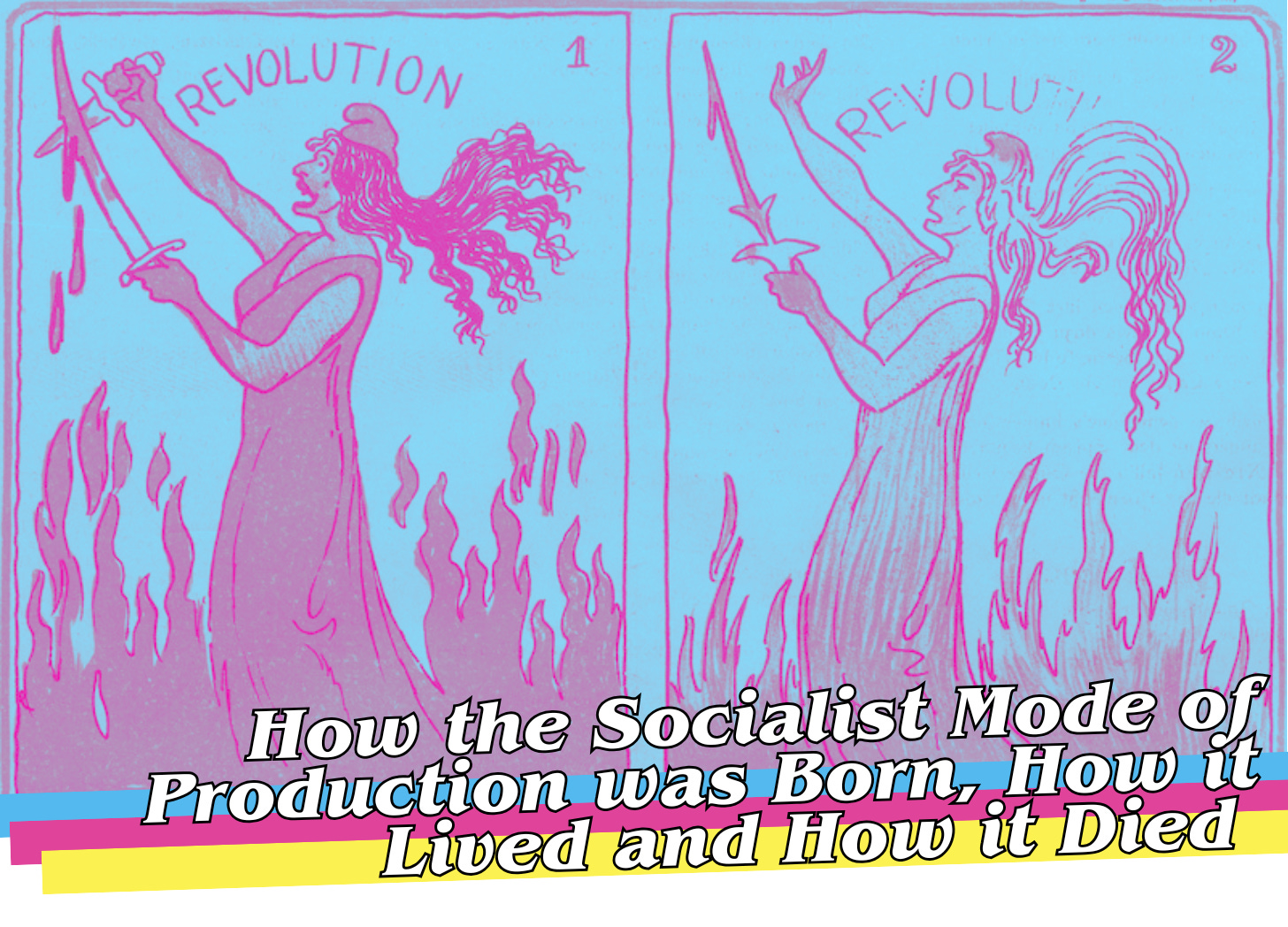
Illustration via Dansk Jävlarna.
Introduction
One of the biggest problems with the communist movement is that we know where we want to go, but we don’t know how. We all know we want a communist society, without classes, money, or the state, but we don’t know what specific steps to take to get there. Reform or revolution? Socialism in one country or permanent revolution? These were some of the debates that arose historically.
Therefore, many communists devote themselves to reflecting on the transition from capitalism to communism. Obviously, this leads to disagreements about what can be considered “socialism” (understood as the transition from capitalism to communism), which leads many communists to identify with one another based on which specific examples of societies that have claimed to be socialist they support, or if they don´t support any.
Was the USSR socialist? Is China? Is Cuba socialist? Is North Korea socialist? Is Venezuela socialist? Is Sentinel Island socialist? Is Antarctica socialist? This is discussed cyclically.
My working hypothesis is that all of these discussions are actually wrongly posed, because they are looking at it the wrong way. In other words, the equations are flawed because the numbers used are incorrect.
What I propose is that we need to rethink how we conceive of socialist transition beyond what I consider to be a flawed theory of a “socialist mode of production”,1 which leads to not being able to see the important aspects of socialist transition clearly. That is, socialist transition has no dialectic…
But I get ahead of myself. Before we can talk about the concept of socialist mode of production proper, we need to examine Marxist historiography on transition more in depth.
History
Most Marxists lack a coherent view of historical materialism and therefore lack a full conceptualization of history. Many view modern and premodern history as completely separate. For example, they will believe that modes of production only change with revolutions, but that in a given country, the old mode ceased to exist peacefully.2
Part of my approach aims to help unify the historical materialist model, attempting to explain changes beyond a schematic version of the phases and revolutions model. This does not mean that I completely reject the idea of revolutions and phases, but I do want to make them more complex.
The historical example with which I want to compare socialism is the transition from feudalism to capitalism or mercantilism, understood as the transitional period between feudalism and capitalism where merchant capital predominated and developed alongside proletarianization.
Anyone familiar with historical materialism knows that the basic framework of historical materialism is: from classless society/primitive communism to slavery, feudalism, capitalism, and eventually communism. Obviously, the theory is more complicated than this framework; even in the writings of Marx and Engels, they discuss other types of phases, and an important part of their theory is how capitalism lays the groundwork for communism. Another important part is that changes in modes of production are caused by changes in the productive forces (the capacity to produce and the level of technology), which I discuss more in the next section.
But more generally, what is historical development? The “classical” style of historiography (in the style of Leopold von Ranke) would say that history is the succession of stages where society goes from barbarism to a higher, democratic bourgeois civilization. Marxism is of course opposed to this view (Marx´s historiography was ahead of its time) but it did not stop several of its followers, such as the Mensheviks (who did literally believe backwards countries were fated to become advanced bourgeois ones), from taking on parts of this approach.
In my view, history is a multitude of processes, which compete and fight with each other, and most importantly, eventually converge. These processes are the work of human beings acting within their socially determined environment, shaping it and being shaped by it. Stages aren´t bad per se, but only make sense insofar they exist to explain processes, and on their own aren’t worth much. To see history this way is to see it as a total history, a “history-problem”, a conceptualisation championed for example by the Annales d’histoire économique et sociale magazine.
Capitalism proper begins with the Industrial Revolution, but before this, there was a “germination” of capitalism due to mercantilism, which lasted approximately from the sixteenth to the eighteenth century.
But in fact, the multitude of processes which make up capitalism began to turn through all of human society.3 Only around the Industrial Revolution did they (proletarization, primitive accumulation, etc etc) begin to be developed freely. Before, these were blocked or restricted by other processes. Both slavery and imperialism precede capitalism, but are given a new life under it. Arrighi had a similar idea, as he claimed Great Britain was the first capitalist great power because it fused capitalism with imperialism.4
Unicausality doesn’t exist in history, only a multitude of competing processes.
In the last section of “Poverty of Philosophy” Marx says:
In the bourgeoisie we have two phases to distinguish: that in which it constituted itself as a class under the regime of feudalism and absolute monarchy, and that in which, already constituted as a class, it overthrew feudalism and monarchy to make society into a bourgeois society. The first of these phases was the longer and necessitated the greater efforts.5
(Emphasis mine.)
Marx and Engels viewed absolutism, that is, the feudal political system in the era of mercantilism, as a hybrid regime between the bourgeoisie and the feudal lords (as Engels mentions in “The Origin of the Family”). However, historian Perry Anderson offers a better analysis, arguing that under absolutism, feudal society and therefore the power of the feudal lords were maintained, but that absolutism was the form the feudal state took in response to the growing power of the bourgeoisie.6
Eventually, the Industrial Revolution emerged from mercantilism, and with it, the “Double Revolution”, in Hobsbawm´s terms. Here we are fully on capitalist terrain. However, it cannot be said that mercantilism was its own separate mode of production, since in it the class balance only partially changed, i.e. the bourgeoisie did not take full power.
Let´s see how Engels describes the bourgeois revolutions in his article “Karl Marx”:
When the towns arose and with them a separate handicraft industry and commercial intercourse, at first internal and later international, the urban bourgeoisie developed, and already during the Middle Ages achieved, in struggle with the nobility, its inclusion in the feudal order as likewise a privileged estate. But with the discovery of the extra-European world, from the middle of the fifteenth century onwards, this bourgeoisie acquired a far more extensive sphere of trade and therewith a new spur for its industry; in the most important branches handicrafts were supplanted by manufacture, now on a factory scale, and this again was supplanted by large-scale industry, which had become possible owing to the discoveries of the previous century, especially that of the steam-engine. Large-scale industry, in its turn, reacted on trade by driving out the old manual labour in backward countries, and creating the present-day new means of communication: steam-engines, railways, electric telegraphy, in the more developed ones. Thus the bourgeoisie came more and more to combine social wealth and social power in its hands, while it still for a long period remained excluded from political power, which was in the hands of the nobility and the monarchy supported by the nobility. But at a certain stage — in France since the Great Revolution — it also conquered political power, and now in turn became the ruling class over the proletariat and small peasants.
(Emphasis mine).
That is to say, before taking power through revolution, the bourgeoisie developed its power within feudalism.
To clarify, I’m not suggesting a kind of reformism where the proletariat should focus on growing in power within capitalism. What’s striking is that, taking these quotes into account, we can see that Marx and Engels conceptualized the transition from feudalism to capitalism as a gradual development (which was consistent with their dialectical philosophy).
However, there is something that distinguishes the capitalist system from previous systems: its total international form as a world-system, where capitalism and the capitalist world-system are one and the same. Which is to say, capitalism isn´t made up of several regional interlocking plural capitalist economics, but is rather one single system.
Being international, the entire globe ends up under the domination of capitalism; capitalism is completed when the world-system is fully constituted. Therefore, fighting capitalism is also fighting the world-system it forms.
All of this shows that the reality and theory of the transition between modes of production is somewhat more complex than the common scheme, which in itself is nothing new. But my argument is that if there was a period of maturation of capitalism into capitalism proper, within what was the feudal system, the same can be said of communism.
Developing the question further, what distinguishes one mode of production from another? There are many ways we can define the question, but I will try to simplify it with one main measure: the amount of power a particular class has over society. Thus, the more power the feudal lords have, the more feudal the society; the more power the capitalists have, the more capitalist the society; and the more power the workers have, the more socialist/communist the society. The difference with all other previous modes of production is that once they have full power, the proletariat can abolish the entire class system. (Of course, we cannot measure the different modes of production exactly in degrees, but this is for illustrative purposes.)7
Therefore, before taking power, a class must develop (it must “constitute itself as a class”) within the society in which it emerges. This was easier for the bourgeoisie within feudalism due to its estate-based, organicist, and decentralized nature, but it is not possible for the proletariat within capitalism, since within it, the conditions of the proletariat are never assured (unlike those of the peasants). This means that there is a limit to how much the proletariat can be co-opted, and partially explains the greater number of revolutionary attempts in capitalism compared to the long history of feudalism.
However, to completely destroy capitalism, the proletariat needs to destroy its world-system. That is, for the proletariat, the analogue of early bourgeois mercantile expansion is the attainment of state power through revolutions, because capitalism cannot integrate the proletariat as a class. If for the bourgeoisie, bourgeois revolutions were its crowning glory, for the proletariat, they are the midpoint of the struggle.
If the history of the bourgeoisie had two phases (constituting itself as a class within feudalism and carrying out revolutions), so too did the proletariat, but two different ones (constituting itself as a class and seizing state power, in order to then destroy the capitalist world-system.)
Therefore, the proletariat only completes its development by destroying the global dimension of capitalism and establishing communism throughout the world. This process is gradual, as the Leninist theses of the “unequal development of capitalism” explains that revolutions are much more likely to break out in the weak links of the capitalist chain.
On another note on revolutions and revolutionary processes, I think we should take note of already existing elements in society which have the potential to converge to create revolutionary change (for example, some communal links that exist in societies which regained more cultural background from the pre capitalist era) but without overestimating them (as the narodinki did with the traditional Russian communes). Paraphrasing Benjamin,8 we could say we have a duty to rescue the past, i.e the historical processes which began in the past that can serve as signs towards a post capitalist society. Communism will be the convergence of a multitude of processes.
Now, we will briefly examine classical Marxist writings on the transition to communism.
The ancient writings
How did the idea of socialist mode of production come to be solidified?
Most obviously, the writings of Marx, Engels, and Lenin do posit a transition between capitalism and communism that is not immediate. This is in fact one of the major things that distinguish communism from anarchism or older socialist variants like Blanquism.
I’ll be brief on this issue because Marx and Engels were never very clear about the future communist society and the transition to it, which makes sense, since they didn’t want to dictate what the revolution should be like, as the utopian socialists did.
Let’s see “Critique of the Gotha Programme”, where Marx is most explicit on the issue:
What we have to deal with here is a communist society, not as it has developed on its own foundations, but, on the contrary, just as it emerges from capitalist society; which is thus in every respect, economically, morally, and intellectually, still stamped with the birthmarks of the old society from whose womb it emerges. Accordingly, the individual producer receives back from society – after the deductions have been made – exactly what he gives to it. What he has given to it is his individual quantum of labor. For example, the social working day consists of the sum of the individual hours of work; the individual labor time of the individual producer is the part of the social working day contributed by him, his share in it. He receives a certificate from society that he has furnished such-and-such an amount of labor (after deducting his labor for the common funds); and with this certificate, he draws from the social stock of means of consumption as much as the same amount of labor cost. The same amount of labor which he has given to society in one form, he receives back in another. Here, obviously, the same principle prevails as that which regulates the exchange of commodities, as far as this is exchange of equal values. Content and form are changed, because under the altered circumstances no one can give anything except his labor, and because, on the other hand, nothing can pass to the ownership of individuals, except individual means of consumption. But as far as the distribution of the latter among the individual producers is concerned, the same principle prevails as in the exchange of commodity equivalents: a given amount of labor in one form is exchanged for an equal amount of labor in another form.
and
In a higher phase of communist society, after the enslaving subordination of the individual to the division of labor, and therewith also the antithesis between mental and physical labor, has vanished; after labor has become not only a means of life but life’s prime want; after the productive forces have also increased with the all-around development of the individual, and all the springs of co-operative wealth flow more abundantly – only then can the narrow horizon of bourgeois right be crossed in its entirety and society inscribe on its banners: From each according to his ability, to each according to his needs!
On the political regime:
Between capitalist and communist society there lies the period of the revolutionary transformation of the one into the other. Corresponding to this is also a political transition period in which the state can be nothing but the revolutionary dictatorship of the proletariat.
Although it’s ambiguous enough that this “transitional period” can be taken to be the socialist mode of production (as it’s usually interpreted), I also think it’s possible to take my point of view, that there is no “middle stage” between capitalism and communism. Politically, it’s interesting that several authors make a distinction between the “dictatorship of the proletariat” and socialism, but in political terms, Marx only mentions the “dictatorship of the proletariat” as a form of state.
Lenin identified “the first phase of communist society,” which Marx mentions, with socialism. I feel this is perhaps taking Marx’s writing too literally, but Lenin was still able to understand that socialism was the beginning of the development of communism, not a completely separate stage.9
However, Lenin also introduced the other theory that goes hand in hand with the theory of the socialist mode of production: the theory of the transition to socialism through state capitalism (which, according to Lenin, was the prelude to socialism). Like a matryoshka doll, phases keep appearing.
In reality, these two theories arise from the productive forces thesis: the focus on the development of productive forces to change the mode of production. In the previous section, I briefly discussed how, in Marxist historiography, it is developments in the productive forces that generate changes in society.
The productive forces theory does have a basis in reality: It is difficult to run a society if it cannot sustain itself and is technologically backward. Furthermore, this conception is supported by some passages from Marx and Engels, such as this one from “Principles of Communism.”:
17 Will it be possible for private property to be abolished at one stroke?
No, no more than existing forces of production can at one stroke be multiplied to the extent necessary for the creation of a communal society.
In all probability, the proletarian revolution will transform existing society gradually and will be able to abolish private property only when the means of production are available in sufficient quantity.
In this passage, Engels clearly places the development of the productive forces as the primary task of the revolution. This makes sense if we consider the context of Marx and Engels: they focused on the core capitalist countries (albeit at a time when these had not yet fully developed). In their conceptualization, the focus on the development of the productive forces was likely an initial but short-lived phase of the proletarian revolution.
However, the revolutions did not occur in these countries, but rather in countries with limited industrial development, where naturally developing the productive forces would be a more arduous task.
Several of these states formed the socialist bloc, and obviously did not operate like normal capitalist countries. Therefore, it was reasonable to consider them their own mode of production.
Conclusion
Returning to the topic of the tasks of the proletarian revolution, it is one thing to emphasize productive development, and another to equate this development with the ultimate goal of communism. This is what ended up happening in the Soviet Union, where Khrushchev even said that it was possible for the Soviet Union to achieve communism on its own. This was in line with the broader state socialist project.
The USSR officially began to consider itself within the socialist mode of production during Stalin’s rule, after years of civil war and famine. Stalin sometimes, paradoxically, declared that under socialism there was no class struggle and that under socialism, the class struggle intensified (which led to the purges). This makes perfect sense considering the government’s need to legitimize itself.
Imagine you are a peasant in Eastern Europe who spent years fighting for revolution: Would you rather hear that after years you have achieved socialism or that you are now in the slow transition from capitalism to communism, a transition you will likely never see completed in your lifetime?
Industrializing the USSR (”developing the productive forces”) was a practical necessity, so this goal became the way to achieve socialism.
To clarify, I am not suggesting some kind of conspiracy on the part of communist leaders to hide True Marxist Theory. I am simply saying that political positions are adopted for practical reasons.
In certain respects, planning does offer better production than capitalism, as it is a rational system rather than the irrational capitalist one. This can be seen in the rapid industrialization that countries adopted a model of this type and in the adoption of state capitalism measures by many post-colonial countries. But capitalism will always have the advantage until communism achieves its final victory, since capitalism has an entire world-system and can simply exploit workers further to intensify production.
In other words, communism must be more than a development model.
In my view, several groups in the 20th century managed to independently develop partial answers to the question of advancing socialism after seizing state power, but as they did not converge, a way to solve the riddle was not synthesized. It is now our duty to have these streams converge.
In a following essay, I plan on continuing this line of investigation, detailing how I believe the transition to communism should be conceptualized.
Coda
[I originally wrote a first version essay to come to terms with the communist parties style marxism-leninism I swore allegiance to from the ages of 18-19. As such, it´s a “Dear John” letter to this tradition.
I did not fully reject my previous views as a simple negation, by swearing full allegiance to another tradition. Rather, I wished to extract what had drawn me to it and try to escape the dogmas which have plagued Marxism since the 20th century.
My full break came centered on the idea of socialist transition, on what we are fighting from.
In this new version of the essay, I changed the obnoxious writing style, toned down the WSA terminology (I was going through a phase when I wrote the first draft), revised the bibliography and changed some unnecessarily polemical aspects.]
The Marxists.org “Glossary of terms” describes “Mode of Production” as:
“The method of producing the necessities of life (whether for health, food, housing or needs such as education, science, nurturing, etc.).
The Mode of Production is the unity of the productive forces and the relations of production. Production begins with the development of its determinative aspect – the productive forces – which, once they have reached a certain level, come into conflict with the relations of production within which they have been developing. This leads to an inevitable change in the relations of production, since in the obsolete form they cease to be indispensable condition of the production process. In its turn, the change in the relations of production, which means the substitution of the new economic basis for the old one, leads to more less rapid change in the entire society. Therefore, the change in the Mode of Production comes about not through peoples volition, but by virtue of the correspondence between the productive relations to the character and level of development of the productive forces. Due to this, the development of society takes the form of the natural historical change of socio-economic formations. Conflict between the productive forces and the relations of production is the economic basis of social revolution.”
For the “theory of the socialist mode of production” I propose the following: I propose the following definition: “The theory of the socialist mode of production is the theory that socialism constitutes a mode of production of its own, just like capitalism or feudalism, and that this mode of production serves as a transition between capitalism and communism. This mode of production is characterized by state/worker control of the means of production, while maintaining the use of money and other aspects of capitalism, and may or may not be equivalent to the “dictatorship of the proletariat,” depending on who proposes it.”
This is most clearly seen in the debates around the history of socialism in the 20th century, where people insist in the ability of traitorous cliques to fully destroy the socialist mode of production. In reality, a mode of production cannot depend on a single leader or political line.
As an example of looking at the earlier origins of capitalism: Los orígenes del capitalismo en la Inglaterra medieval, Christopher Dyer.
Hegemony Unravelling Part II, Giovanni Arrighi, p 97.
Note that Marx mentions two phases, rather than one phase, an intermediate phase, and total victory.
Lineages of the Absolutist State, Perry Anderson.
Wallerstein would disagree with my characterization of mercantilism. He characterizes the era of mercantilism as an agrarian capitalism, which I disputed with my measure of "class influence" above, and I lean toward Anderson's view on the matter. In my opinion, one cannot say that there is full capitalism if the power of the bourgeoisie is not total and spread worldwide.
Theses on the Philosophy of History, Walter Benjamin.
 | A guest post by
|