


Illustrations via Dansk Jävlarna.
I’m on a quest to get a better handle on the feminist fantasy-myth-history “retelling” genre. Sharon Emmerichs’s Shield Maiden shares the same source material as my own novel – which can be summed up as “What if Beowulf was some kind of monstrous fish-woman?” – so I figured it would be a good place to start.
Let’s take a jaunt through the book’s scaffolding real quick. Here’s what it looks like. Yes, yes, we’re not supposed to judge a book by its cover, but I presume we’re supposed to at least glean something from its blurbs and marketing text. Otherwise, how do we know what books to grab on a lark instead of the 1000 others on our reading lists?
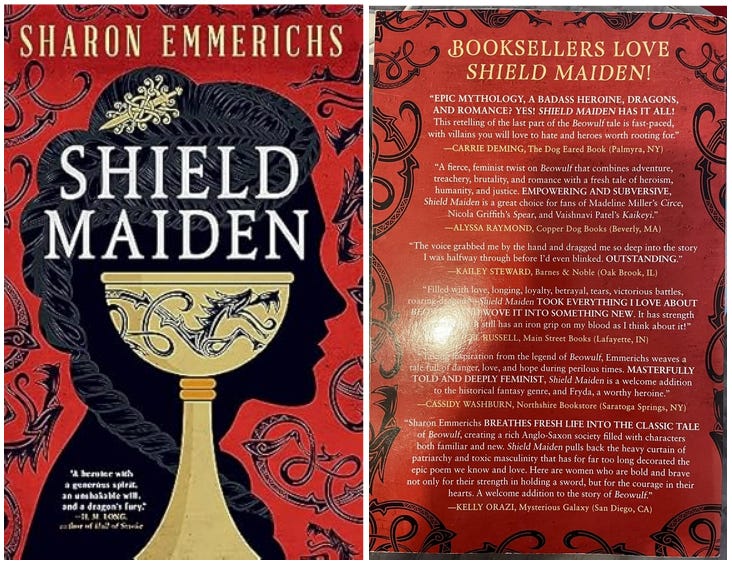
I’ll highlight a few things. First, we have the woman’s face emblazoned across the cover. Our heroine is front and center, and that little tagline hammers the point home: it advertises not a plot or a world, but a heroine, “willful” and “generous.” Beyond that, the blurbs – although we can of course assume that at least some of these writers never read the book, because, I mean, Kailey Steward, come on – double down on the same focus. The heroine is “badass.” And her badassery is linked explicitly to feminism – a “feminist twist” on Beowulf, DEEPLY FEMINIST!!!!, “pulls back the heavy curtain of patriarchy and toxic masculinity that has for too long decorated the epic poem”.1
The marketing is clear: there is a Strong Female Protagonist ™, and this book is a feminist retelling of Beowulf. It situates itself clearly within this genre.
So I’m thinking, yay, lucky me!
Now, the plot:
Shield Maiden takes place at the end of Beowulf’s life, when the dragon begins to stir. It follows Beowulf’s niece, Fryda, a young woman who wants to become a warrior against the will of her father. When Fryda was younger, she fell into a fissure in the earth caused by the stirring of the dragon and permanently crushed her hand. Fryda trains as a warrior in secret, helped by a blacksmith, Bryce, who is later revealed to be Unferth from the original poem. She begins to experience strange bursts of inhuman strength. She’s in love with a slave in her father’s house, and her brother, Wiglaf, is disgusted by their relationship. Wiglaf has always been an unmotivated loser, but when their father names a renowned warrior as his heir in Wiglaf’s place, Wiglaf conspires with an enemy king to kill him and inherit his throne. Beowulf gets involved. Short sections in between chapters describe the gradual awakening of the dragon on a hoard of treasure beneath the earth. When Fryda’s boyfriend gets banished as part of Wiglaf’s machinations, he stumbles upon the treasure and steals the cursed goblet that binds the dragon in sleep, hoping to buy his freedom. The dragon wakes and attacks. Fryda fights her off, and Beowulf, acknowledging her bravery, names her his heir. The warriors devise a plan to trap the dragon. In the midst of this final fight, Wiglaf betrays and murders Beowulf. Fryda realizes that her bursts of strength have been given to her through the dragon, borne out of the dragon’s desire to die and be freed of her curse. She kills the dragon and becomes queen.
Come back to me, children.
I’ll start with the positives. As a known Beowulfhead, I obviously liked that Shield Maiden is inspired by Beowulf. I also enjoy when a story plays on its readers’ knowledge of its own tragic end; the scenes of the dragon slowly waking up made for a neat ticking clock of doom.
Additionally, as you might know if you’ve read my fiction, I am compelled by the idea of twins and twinned destinies. Fryda’s twin, Wiglaf, explicitly functions as the inverse of her. At one point, he even says he regards them as two halves of the same person. Wiglaf’s jealousy over Fryda’s romantic relationship is compellingly uncomfortable (although the moment Fryda points out its incestuous undertones, Wiglaf turns to the camera and assures the audience that of course it isn’t like that, gross!).
Coupled with this is the twinning of Fryda and the dragon. This bond between protagonist and monster was, I think, Shield Maiden’s most incisive feminist idea, turning the traditional hero(man)/monster dichotomy on its head, assigning agency to the monster in its own destruction, casting monster and hero as counterweights in balance instead of conquered and conquerer. It complicates traditional monstrousness further, too, in that the dragon’s actions were precipitated by human injustice via the nature of her curse, not an ontologically evil nature.
So, yes, there could’ve been a cool story here. Uh… unfortunately… it wasn’t the story I read.
In practice, Shield Maiden’s plot was predictable, its relationships conventional, its ethics uncomplicated. Good beat evil. The prose itself was procedural and bloated. Most of the most interesting ideas I just described were handwaved away to make room for an autopilot girlboss fantasy plot where the heroine proves she’s badass and everything turns out gravy.
My most major issue, though, was with the book’s core feminist ethos. I do, in theory, like the broad idea of “reclaiming” history and myth through feminist retellings. I know some people think the whole genre is cringe. But, in theory, I support it.
Okay, relative to Beowulf, which is a deeply sexist piece of literature,2 Shield Maiden is feminist. I guess. But in a modern sense… guys, this shit is not feminist.
Shield Maiden falls into a pattern that I’ve seen in a lot of “feminist reimaginings.” Honestly, I haven’t not seen it in any of them. I first noticed it when I read Circe by Madelline Miller, a book which I fucking hated.
…Alright, just to go on a Circe tangent – Circe was sold to me as taking a scalpel to the misogyny of ancient myth, empathetically telling the story of a much-maligned figure and giving her voice power as never before, yadda yadda we know the drill. But the actual plot of the book is, basically: everyone is horrible to this woman throughout her whole life, including other women, and all the women she encounters are hateful bitches who just wanna keep her down, and then finally she runs off with a man who respects her and that’s the happy ending.3 Like. What?
Shield Maiden has Circe beat in that all the other female characters aren’t hateful bitches. But that’s because, uh… there low-key aren’t other female characters.
There were some really interesting potential characters. There’s the blacksmith’s lover, an older woman in love with Unferth despite his grief preventing him from acknowledging their relationship. I found her restraint and dignity compelling. I also wished she had more than two scenes. She and Fryda could have had an interesting relationship, given that Fryda has a bajillion father figures and not a single mother figure… but they never speak.
There’s also a cook in the castle who’s abusive to the slaves. It’s mentioned constantly, but it’s never relevant to anything, other than to prove that Fryda’s boyfriend is suffering :(, and that Fryda will be a good ruler, because she advocates… for slaves not to be beaten. Sure, okay.
Then there’s Fryda’s best friend, Hild.
…Yeesh. Alright. Hild’s narrative is that she immigrated from Africa as an indentured servant. Awesome! People did do that. People have been traveling around to different continents since people were invented, and the inclusion of nonwhite characters in European history-inspired fantasy is not Immersion-Breaking Due to Le Wokisme, but simply reasonable extrapolation upon the setting.
This can be done well. I believe strongly in doing this well. But I don’t think it was done well here. Because, frankly, the only role Hild served in this plot was to be the Black friend of our main character. We barely ever see any conflict involving Hild or within her, any character development, any real emotional relevance. She exists solely in service to Fryda, as a symbol for Fryda to occasionally engage with. It’s clear Emmerichs didn’t care enough about her to make her a character in her own right. I don’t know that she would’ve existed if Emmerichs didn’t think oh, shit, all my characters are white, they’re going to be mean to me on Twitter.
It sucks. It’s a shame! A person of Hild’s background, in this setting, should have a terrific wealth of experiences and insights to weave into overarching themes of marginalization, narrative subversion, and myth. There could’ve been so much more to Fryda and Hild’s relationship, as women in this setting, as women who want to be warriors and can’t, as friends with a massive power differential. Unfortunately, none of it comes through.
I think part of the reason is that even though one of the main pillars of this book is the a woman reclaiming her power tagline stuff, it’s not really institutionally discouraged in-fiction for women to be warriors. It’s mentioned many times that women and men are fighting side-by-side, and female warriors are accorded the same respect as men. Really, the only barriers to Fryda becoming a warrior are her disability and her father’s disapproval.
So there’s… not actually that much reason for women to stand in solidarity with each other, as a class. There isn’t much discussion of patriarchy or misogyny, either, which is what you would expect coming into a book that presents itself like this one does. These are the factors that could have brought female characters into the foreground even if they didn’t have prominent roles in the main plot, but, strangely, they weren’t there.
This is really kind of a feel-good book. It doesn’t take you anywhere uncomfortable, and the moment it even skirts close, it smashes through the fourth wall and reassures you. To be honest, this book is just not really interested in feminism, or in the challenges women face, or the bonds between women. It’s interested in a pretty girl getting badass magic powers and killing a dragon, and also Beowulf and all his badass warrior men think she’s cool.
Look, I wouldn’t give a shit if this were any other book. Wish fulfilment doesn’t offend me. Neither does unfeminist literature, when we get right down to it. I don’t go through the world getting mad at this stuff.
It’s just that this particular book comes out strong, claiming to be something, dressed up in all the livery. Big and bold on the back cover is the line, “Both epic and intimate, Sharon Emmerichs’s extraordinary debut novel reimagines Beowulf from the perspective of a young woman reclaiming her power.” I mean, come on! The trappings of this book make big promises, capitalize on a certain perception, and then fail to deliver. She’s not “reclaiming” a power that she already has. And still I wouldn’t give a shit… except that it does this with Beowulf! Beowulf!!
This essay was originally posted on J.M.’s personal newsletter. Check it out for further reviews:
The reason this is so severely getting my goat is that Beowulf itself is such an interesting text to analyze from a gendered perspective. It is a very masculine text. Its central matter is, to me, the meaning of manhood. What does it mean to be a worthy man? To be honorable, to be strong, to have power? What kind of creature falls outside that boundary of manhood? What is the responsibility of a man to his people, to his legacy?
However, there are also women woven throughout the background of the tale. You get vignettes about Modthryth and Hygd, an evil princess and a good queen (Modthryth later reforms through marriage and becomes virtuous) made meaningful in their moral juxtaposition. The wives of kings, household managers, peaceweavers, political agents, enrich the setting. There are too the hands that pour the mead, that stoke the fires. It’s such an interesting thing to see where the women are in this story, where they are not, what roles they’re fulfilling, and what themes they represent. Then, too, there is Grendel’s mother, one of the central monsters of the poem. There’s a lot to be said about the role of monstrousness and deviance within Beowulf’s highly gendered framework.
Finally, at the end of the poem, it is a woman mourning Beowulf’s death, crying, lamenting the loss and the dark days to come. Women take the center stage as mourners, framing the ending of life as well as its beginning. The Iliad does this too.
And this – this one – this is the one that gets me. The mourning woman doesn’t even bear a mention in Shield Maiden.
I mean, brother! This is emblematic of my whole problem, see. This genre, the feminist retelling genre, makes a claim: it says, “we’re rewriting history to include women.” But this ignores the fact that the women are there.4 Again and again, these retellings, reimaginings, rehashings assert that that history has to be reimagined in order for women to be important. In pretending that we’re staking a claim for women in history, we’re erasing the claim that is rightly theirs.5
Guys… it’s bad. It’s bad that we keep doing this.
What’s sad is that Shield Maiden could’ve been such an interesting story. A woman becoming the successor to the demigod Beowulf, paragon of masculinity – a woman maimed and betrayed by her own twin, becoming the embodiment of fate – a union of violence and mercy, traversing the boundary between hero and monster. I mean, sign me up!
But this is where Shield Maiden, Circe, and other books like them fail: by shunting women into the background, by failing to portray any meaningful solidarity among women, refusing to truly engage with source material and instead duct taping modern libfem wish fulfillment over it, they end up being more misogynist than the canon they seek to “reimagine.”
Alas.
On a pure craft level, this book is also middling. I feel like the prose could have elevated this book significantly. It didn’t. It never trusted the reader to pick up on subtlety, and insisted on hammering every passing idea into my head over and over. Just… a ton of adjectives. A fuckton of adjectives. Look, I’m a patient reader. I like thoroughness and I like being taken along the specific meandering paths of an author’s insanity. I enjoyed Moby Dick. If you want to devote huge portions of your story to describing whale oil, and if that description adds something unique to the story, I will sit my happy ass down and read 1000 pages of it.
Emmerichs didn’t do that. Honestly, more lush scene-setting descriptions would probably have helped this book out; somehow, it was both ungrounded and over-described. That’s because what description she did include was painfully procedural. Adjectives upon adjectives wore you down with the same information you would’ve gleaned from the words surrounding them – I’m too lazy to find a quote, but I’m talking “his sky blue eyes glittered brightly” type shit. It seems like it’s trying vaguely to achieve that quintessential Fantasy Tone, although not so stylized as to be opaque to the median reader. It has to sound lush, even if it isn’t trying to be lush.
If there was a banger line or a dramatic moment, Emmerichs would restate it a bunch of times to make sure that you understood that it was banger. She would do these long buildups of filler words, nothing phrases, so that when you hit the line she actually wanted to write you’d be like woah, that hit so hard. If I ever get my hands on a copy of the book again, I’ll insert a picture of a specific page here. It hangs over my shoulder wherever I walk like a vengeful ghost.
Naturally, there’s no notion of this story being a conversation with the reader, of the reader’s interpretation amounting to any significant part of what the story does. It’s a one-way performance. In my opinion, the best authors understand that they will never be able to beam their story into the reader’s imagination exactly as it occurs in theirs, and choose instead to explore and exploit this gap. The most frightening monster, after all, is the one I don’t describe at all.
Look, I’m not asking Shield Maiden to be some metatextual masterwork, okay? I get it. I just feel like nobody took a fine-toothed comb to this at all, and if they had, it would’ve been more enjoyable. The pacing isn’t great and the plot doesn’t justify the wordcount. It’s a 200-page story told over 400 pages. I would’ve been much more engaged if it embraced that and told a decent story at an engaging clip rather than trying to be some kind of long-winded epic.6
Ultimately, all the prose did was tell you exactly how Sharon Emmerichs pictured things happening. He opened the door. He stopped. He tossed his braid of wild fiery red hair over his well-muscled shoulder.
I wouldn’t mind this so much, except the things I actually wouldn’t be able to picture on my own, she didn’t describe! I would’ve wanted to delve into the life, the architecture, the agriculture, and everything else about this old Geatish culture. Emmerichs is apparently well-qualified to do this, since she’s actually a professor of old English literature. But none of it was present.
This book also does a rather poor job of developing stakes. There are very few material forces at play. The world feels almost uninhabited; despite all of the politics and betrayals happening within the royal family, the common people don’t have an opinion, and their favor/disfavor holds no weight. It made everything feel like individual squabbling, not events that could change the trajectory of a whole nation’s fate. Maybe I’m spoiled by Robin Hobb. We need drama, lady! We don’t need ten billion scenes of Fryda sparring with her friends.
The one other thing that really annoyed me is… we don’t fucking see Beowulf die. We’re in the middle of the big climactic fight with the dragon, and Fryda looks away and the next minute Wiglaf’s betrayed Beowulf and he’s dying. Just like that. Fryda comes over. By this point, Beowulf has already named her his successor, and now he gives her his dying words. This could be interesting, right? A big conflict has been that Beowulf has only ever seen Fryda as a girl to dote on and never a true warrior. This moment could delve into what it meant for her to be his successor, to have proven herself to him and made him see her fully. And then it. Doesn’t. His last words to her are just calling her a sweet girl.
So… so… the fantasy of this book is supposed to be a girl proving to the men in her life that she’s their martial and social equal, right? But it doesn’t even do that! The ultimate moment for this heroine is still defined by paternalistic affection. It felt like a climax for a spoiled child. As if the heroine really was only a girl being rewarded for good behavior, not a woman warrior rightfully earning her due.
Again, I wouldn’t care, if not for the fact that the latter is the whole premise of the book. That premise was fundamentally marred by this girlish obsession with wanting men’s approval and affection in addition to their respect.
Friends, countrywomen… we need to let go of all this. Power is not a reward for sweetness. Additionally, men are not the arbiters of power. There is no moment where you’re finally strong enough, sweet enough, good enough to be regarded as a peer. You’re not going to be enough, because you’re a woman. You cannot prove yourself strong to a judge who deems you inherently and immutably weak.
Which is fine. Stop trying. You don’t become an Empowered Woman through the approval of your uncles. Same as men, women are empowered through building things, challenging themselves, and letting go of the need for constant approval.
But the thesis of Shield Maiden is supposed to be that a woman can be strong enough to make men respect her.
And then she can’t. Even. Do. That.
This literature sells itself as a way to find stories in meaningful conversation with history, to enter a dialogue about women’s place in cultural memory. I wish stories like Shield Maiden and Circe would stop pretending to be something they’re not.
Whatever. Anyway. Shield Maiden was a middling story told in a middling way. It wasn’t ambitious enough to be anything more. It wasn’t ambitious as a feminist work, or as a work of fiction in general, or as a retelling. Although I liked a lot of the concepts in it, I was often annoyed by its clunkiness and unwillingness to really handle any of its themes.
Still, it was readable. I was buoyed along by the neat concepts that came up, even though none of them really came to fruition, and by the setting itself, vague as it was. In my opinion, it sits smack dab in the middle of the distribution curve, no better or worse than the average book.
Which, to be honest, makes me sad. I wanted more from a story inspired by something as rich and complicated as Beowulf, and I didn’t get it.
…I feel like I should end on something positive. I just raked this book through the coals and then told you it was average. Uhh… I did like the sex scene. It was one of my favorite scenes of the book, because it was so focused on Fryda and her body. It was physical and sensation-based, grounded in a way few other scenes were. I thought it was hot because I thought Fryda was hot and I liked reading about her getting down and dirty. My bad.
Recommend: No
Imagine a massive, Meg-style set of jaws welling up from the shadowed ocean bottom toward our tiny ship.
You can argue with me about whether it’s misogynist, but you must at least acknowledge that Beowulf adheres to the ideology of sexism, which is that men and women are fundamentally different and should occupy different spheres of life.
Iron Widow also does this to a baffling extent.
We keep bulldozing over history, claiming Diversity Firsts, isn’t it revolutionary that this book has so many people of color, isn’t it revolutionary that this character is gay, isn’t it revolutionary that this book has women in it, isn’t it – No! Go read Count of Monte Cristo!
Harvard Gazette: “When the slogan [“Well-behaved women seldom make history”] appears out of context, it becomes open to wide interpretation, and has, subsequently, been used as a call to activism and sensational — even negative — behavior. [...] Throughout history, “good” women’s lives were largely domestic, notes Ulrich. Little has been recorded about them because domesticity has not previously been considered a topic that merits inquiry. [...] Ulrich points out that histories of “ordinary” women have not been widely known because historians have not looked carefully at their lives, adding that by exploring this facet of our past, we gain a richer understanding of history.”
I’m bitter about this because my fishnovel draft currently sits at 180k. Yeah, you read that right. I’ve been hacking at this thing for months. I now take lackluster wordcutting as a personal offense.