

Fairies, Autism, Gayness
Exploring the bonds of otherness

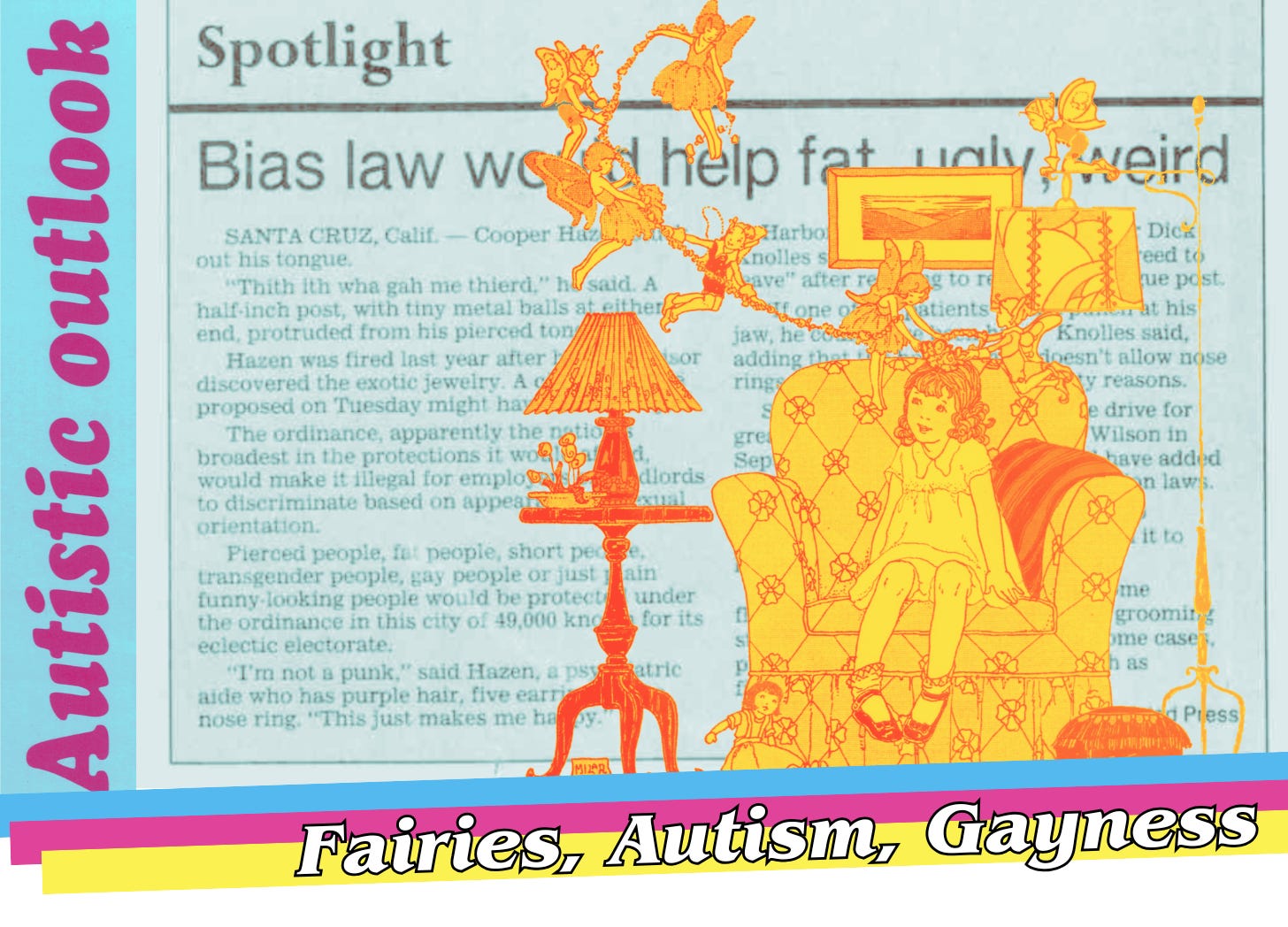
Illustration via Dansk Jävlarna.
A significant part of my gender identity and presentation is the reclaimation of a simple media concept: fag = villain.
You see it all the time, and the concept is introduced very early on. If a man is evil, there’s often a mincing, prissy, delicate nature to him. He moves his hands a certain way, is careful of his clothes, has catty remarks, and may even have more obvious makeup than his heroic male counterparts (all actors wear makeup, and this may be implied in animated designs as well). Though Disney is famous for it, even Shrek – the film series that loved mocking it – falls into this trap as well. Three of Shrek's antagonists are men who are in some way either effeminate or emasculated, fussy with their clothes or hair even if they are physically formidable.
More mature media is just as guilty, and it gets away with more. Joel Cairo is not only prissy, he gets to outright mime fellatio. The crossdressers graduate from jokes to killers. Though the threat, couched in metaphor, implication, and off screen inferences doesn’t need to wait long.
This is, indeed, inescapable. Even such a man who is meant to be complex, leaning positive (he is never simply a hero), will be seen through suspicion. Said suspicion will, too, be tied to his actions, even if he is never untoward in them. What a creep he was in this scene, the audience gleefully remarks… as he does little more than flirt or mince. How horrible, comes the gasp, as hair and bodies are fussed over, pulled from the dreary muck of gender norms.
This weighs on me more heavily at some times than others. It is primarily, a coping mechanism for the internal fear that I am evil, predatory, and depraved. This is a deep-rooted fear, and I adore evil queens of all sorts, including the human ones.
It’s not a given that evil is human… There’s a German song based on one of Goethe’s most famous poems titled Erlkönig, about father riding at night with his son behind him on the horse. The child sees and hears the titular elf king calling for him, but his father sees nothing and assures him nothing is there. Upon arriving home, the son is dead.
There is no explicit homophobic or erotic element in the story. Indeed, the story makes an effort to mention that the elf king promises his daughters to the boy. But it’s not the daughters that menace him. It is the king who menaces him with the promise of sex (which inflames my neurotic trauma in a different way). Perhaps my reaction upon learning this is only evidence of how deep the wounds of explicit association go.
If an older man with no wife interacts with your son, he will infect the boy, and the interest simply cannot be well-intentioned. The acceptable story can only slice up real life, and serve the most desirable pieces. It is not a pure lie (especially not for fairy boys, who live hounded by; youth to be accepted, the desire to conquer them, and many other devils), but it is a lie by omission.
After all, the implication, created by a wife shaped lacuna, is that the man has no taste for women. He seeks out boys because of some animal urge. This is not true. Those who seek much younger partners do not do so because of simple hunger, “twisted” away from its “natural” course. It’s a hunger for power.
This hunting is by no means unique to little fairy boys either; it is directed at girls too. There is yet another key to both these facts. Both are socially sanctioned by pockets of society. Not the majority, no, but by far too many. Even those who do not explicitly sanction these things buy into their echoes: for the fairy to be acceptable, they must not age. When the queen gets wrinkles, send him to the nunnery. These things are not seen as attractive in the effeminate creature, and the effeminate creature must be attractive to be allowed in public. Or else, he must be relegated outside of sex entirely.
The feeling evoked in me, at a time when I am likened to a contagion, and when “widows” “mourn” their partners, should be easy to infer. I am sitting on the porch, yelling to my mother, something is there, something is there. Something inside me is calling out to what’s there, I am becoming. She says, no, nothing is there, you do not want to become. As she steps out onto the porch, there is no daughter: I have become. I pretend to be a daughter for another year, saving money for a binder, cutting my hair, before sitting her and my grandmother down and saying once more: I am becoming. There is no daughter. I do not know that name. She cries. As I am becoming, she cries and mourns and subtly asks, give me my daughter back. Give me my daughter-mother-wife back.
I say, who?
When I was 16 or 17, my literature class had an assignment where we were supposed to write a personal piece- I forget the prompt, but it was vague enough that while most other people in my class wrote real, memoir style pieces, I wrote a fiction story about being accosted by an other self. She screamed at me that I had stolen her life, changed her, with my madness and my limp wrists and my gender. I was the changeling.
The fear in the changeling story- from a modern perspective about autism- is that something “took” your child from you, and you need to get them back. This leads to extremes. In the past you’d expose a baby by the side of a lake or bathe them with foxglove. Today, you see parents giving kids bleach enemas. However, you also see this with trans people. This ranges from the social contagion fear (which is “cured” by isolation), and in “trans widow” groups (groups of usually cis women who were married to closeted or egg trans women, who regard these women as “dead” upon their coming out).
In both instances, there is a sense of ownership over the other person. They were something that belonged to you, that was stolen from you by not behaving the way you wanted. And the “thing”, the person, may try to behave, may try to please these people who claim ownership, but they never succeed fully. It is impossible to succeed fully. For one thing, you often don’t understand what it is you’re supposed to do, and struggle to grasp why you need to do it. For another, obedience often leaves scars on the mind. It causes you to do things that are uncomfortable or painful, and erodes you over time. To tie it back to villains again- uncharitably, this sounds almost like a curse, doesn’t it? You have some hidden, depraved drive, and you can hide in your human skin, but eventually, you won’t be able to keep up. Out you burst, into the light, and then the mayhem starts. This framing is more commonly applied to trans and trans coded villains, of course, and less to autistic ones, but it’s not a hypothetical.
When you call a man effeminate, you may call him a fairy or say he’s “fae”. The latter, personally, contains more connotations of a sissy who may not necessarily hit back and have an honorable fight with you, but whatever he does will be worse.1 Of the fairy who takes the child, rather than the fairy that can be killed by a flyswatter. Mulgarath in his tattered silks of years long gone rather than Tinkerbell (her Disney Incarnation, anyway).
Of madness.
After all, what is more terrible? Being a bit mad, laughing at a funeral, kissing another man- aren’t they all the same, and aren’t they all wretched?
Growing up, I had two primary ways of stimming. Playing with my hair, particularly rubbing it over my lips, was one. The other was pacing. I still enjoy both. The former is innocently perceived: it makes me seem stupid, apparently, and some see it as unhygienic, but that’s fine to be to some extent. Pacing, however, is not. Perhaps the combination of the fact that I often mutter to myself (usually about something I’m writing) and have a serious expression while doing so is more off putting than the motion itself. A relative once likened it to a tiger she’d seen at the zoo. She meant it as a compliment, but the message I received was: This behavior is menacing (supported by the previous reaction of others), something about your natural body is animal in a way mine is not, and as we had an argument over her using racially charged language while discussing my father that was fetishistic a few hours before, that there was an exotic and conquering appeal to me. (I once wrote a poem about that too; I took the skin of a jackal to be contrary. Scavenging animals are a little less appealing to the masses). Suffice to say: I have struggled to feel human.
The fae are inhuman. They laugh at sad times, they cry at joyous ones. They have their own rules for what is appropriate. They are offended at strange things because the gesture carries a different meaning in their eyes. They see things you do not, hear things you do not. “Normal” food is ash in the mouths of those acclimated to them- who’s to say that food outside the traditional offerings of honey and similar is not the same for them (in the realm of metaphor, anyway)?
There’s a concept album I occasionally fuck around with the lyrics for, with a song about this very topic, and the chorus contains the lines “three and six/I’ve never been more than a bundle of sticks”. The numbers are the amount of letters in two words: fae and faggot. A faggot is a bundle of sticks, of course, and some people believe the folk etymology that the slur comes from burning queer men (and those perceived as such). Some claim a similar historical phenomenon regarding changelings- particularly for me, the novel “the Moorchild”.
The main character of the novel is the moorchild, or changeling, herself, named Saaski by her human family. She is primarily visually distinguished; she has too long hands and feet, her skin is dark in contrast to her blonde hair, which is textured. She has a human father and a supernatural mother, which is why she was seen as disfavorable enough to trade for someone else. Neither world is one she quite “looks right” in. She is uninterested in most other children; but her appearance comes first. When people look at you and call you a freak, of course you hardly care to speak to them. Unlike other art dealing with such lonely “girls,” such as the horror movie Excision, I did not pick up on a gendered theme (though perhaps it is owed another reading, as I last read it when I did not know what I was), but the racial reading is clear, and there is a case to be made for an autistic reading. Saaski is unusually obsessed with her father’s bagpipe, and plays it whenever she can; she prefers the isolation of the moors with the company of livestock to other chores (who hardly care how loudly she plays). One can view this as both a special interest and as a form of stimming.
Saaski’s dark skin connects her to the Romani/Traveller coded characters in the story who come to her village from time to time. These characters aren’t subject to quite the same scorn as in real life- for one thing, their children play with the village children. However, it does subtly remind the reader of Saaski’s displacement. These are literal outsiders. They don’t live in the village. They just visit occasionally. Similarly, Saaski is not of the village. Both of them are easy to visually pick out, not from familiarity, but the lack of it. The villagers gradually become more and more intolerant of this, culminating in a threat to throw her into a ceremonial bonfire. Saaski, of course, escapes- but before she does, she rescues her parent’s “real child”. And while Saaski is racialized in an ambiguously European, quasi-Irish village, those who racialized her were themselves racialized.
If you listen to the podcast Lore produced by Aaron Manke, you may remember a woman named Bridget Cleary (Bríd Uí Chléirigh) who was murdered by her husband because he thought she was a changeling. What Manke leaves out in his telling is the political afterlife of this tale; after all, his listeners are here for the morbid excision of their daily anxiety. I say this not wholly derisively; the urge to purge one’s terror through the recounting of the extremely violent is natural, and as someone who grew up terrified of death, I did the same from a very young age.
However, this morbid excision is precisely what made Brigid’s death useful as a political tool of English colonization. Its details are appalling, but the listener is drawn to depravity on foreign shores. Distance and/or time make indulgence in the tale safe by varying degrees. Taking a story from such a distance means those who chose to transmit it can use it to influence how you think of those from the place it happened in- and who will you be to know differently? Even in this Information Era, misinformation spreads. And search engines increasingly degrade in quality, newspapers paywall their sites, and junk information is algorithmically copied to dozens of sites. In the 19th century, the situation was even worse.
Bridget Cleary was a married woman, aged 26 years old when she died. Her marriage lasted 8 years, with no children. During her marriage, she lived with her parents instead of her husband, and had financial independence. She was educated in literacy, basic math, and middle class manners. Upon her mother’s death, her father became her responsibility and the three moved in together. Her husband, compared to their milieu of the rural Irish working class, was more educated and trained in a skilled trade. Being a cooper had made him a good deal of money, including after he’d moved in with his wife and father in law. Both dressed well, in a more middle class manner than was typical. Middle class Irish and those aspiring to their position often scorned traditions like wakes, beliefs in fairy lore, etc. The day after her husband killed Bridget, he confessed to two friends and a priest what he and several other men had done. The priest and his friends were shocked- one of his friends tried to get him to bury his wife properly, and the whole group could only conclude Michael Cleary had gone mad. The Irish public too, condemned the affair.
The story of poor Bridget, an independent woman burned to death by her husband who believed she was replaced by a changeling, was easy to spread and easy to twist from a tragedy of European (and global) misogyny, to evidence of a uniquely Irish depravity. Look at these Irish and their strange, violent beliefs! Look at how terrible their men are to their women! Unlike these upright British, who see women as pure and- oh, pay no mind to Spring-heel Jack and Mr. Ripper, they’re just having a chat about work.
Cleary’s death was specifically used to go against Home Rule in Ireland.2 Two bills had already been introduced by William Gladstone, and defeated. This was part of decades of violence between landowners, tenants, and the evicted- which already caused papers owned by Unionists to scoff at the idea of Irish Home Rule. Much was made about if the Irish were intelligent enough to rule themselves, and intelligence came up again and again in the case. Tory-Unionist newspapers explicitly connected Cleary and the Home Rule as the Land Bill, a related measure, came up. Anti-Black comparisons were made, effectively saying the Irish were even more barbaric than the English perception of the Khoekhoe people, then commonly called Hottentot. This comparison between the Irish and Khoekhoe was loaded, as it was also made not long the first Home Rule bill of 1886 was defeated. Other comparisons stated the local people were “in the moral and intellectual condition of Dahomey [Benin]”, that it was precisely what was expected of “savage tribes”3.
A herbal doctor, who may have never met Bridget, though he’d prescribed for her, was initially dragged into the fray and seen particularly poorly by the public. Newspapers described him as a witch-doctor, a medicine man- words typically reserved for African and Native American healers, respectively, and the former being rather derogatory. “Fairy belief” was presented as uniquely Irish and strange- despite many elements of it being popular across Europe, and even beyond Europe.
It is taken as fact that her husband and the 9 witnesses believed she was a fairy, and strongly suggested their behavior would have been not simply recognized, but representative, in many recountings. When Michael Cleary tried to get his friend to come with him to a ringfort to rescue Bridget (at that point, dead) from the fairies, the man relayed in his account that no one took the mystical association of ringforts seriously. His recount of the idea, however, is not the common one. Instead, Mary Simpson’s recount, which is more detailed, is. Mary, notably, was a Protestant Episcopalian, and an outsider among their village due to Irish political tensions.4 All written records we have- even Irish records, which were aware precisely of how this could be used, a tension all who know the violence of another’s gaze and all who know those that view safety in the arms of power understand- of the crime is coverage influenced by colonialism. It happened. All of it happened.
Mary Simpson’s husband was a property defense protector- basically a goon for a landlord during a time when large swathes of Irish people were being evicted and subject to rent hikes. They were commonly physically attacked or boycotted by the populace; this era is in fact, where the word comes from. Suffice to say, it’s very interesting that her account is the one closest to what was said by Manke. Despite this, the Clearys were on good terms with the Simpsons. Another account that uncritically presented a belief in fairies was The Nationalist, a newspaper, which was clearly influenced by the romantic nationalism of people like Yeats. It called the belief quackery as it did so. Previous accounts of deaths (usually children) and injuries caused by attempts to deal with supposed changelings also frequently have others, in and outside their milieu, look upon those guilty as insane, or as speaking in metaphor/euphemism. To say something like “you look like something the fairies left” would at the time, typically be taken as a way of simply saying someone does not look well. A man “making a fairy of” his wife could simply mean he’s been negligent, distant, or even physically abusive. A wife convincing her husband she was a changeling could be leveraged to halt his negative behavior. And to say “she went away with the fairies,” could well mean “she’s been having an affair” or even “it’s none of your business and I won’t say anything more on the matter”.
This episode was one of the six chosen to be adapted to TV, though to my understanding, this adaptation was less objectionable. Manke’s telling, though it mentions similar stories existing in Europe, only recounts Irish examples. It presents these examples as just common belief, and does not discuss how the perpetrators of violence against accused changelings were perceived by others. It does not discuss how a “changeling” could serve as an excuse to abuse and humiliate, or how certain details suggest some of the treatment was ritualized punishment for Bridget’s rumored affair with Mr. Simpson and general arrogance deemed inappropriate to a woman. It presents the belief in fairy forts as entirely and always genuine, and most egregiously, says Jack Dunne uncritically believed Bridget was a changeling, implies he sanctioned killing her, and that Dennis Ganey treated her. He also provides a repulsive account of Ganey’s treatments, designed to engender the same disgust we have for treatments using leeches.
Dunne provided the account of Michael’s claim that Bridget would appear at a fairy fort on a white horse, the one that bluntly stated his incredulity. He himself lived near a fairy fort. He was also a storyteller, which gave him authority. His belief in the fairy lore he told and the spells he was reported to know (likely traditional Irish charms, essentially a counterpart to prayer) is difficult to discern from the record; two famous storytellers of his time themselves wove in themes of skepticism in their work. Testimonies about him and Michael are all complicated by family ties and jealousy, and Johanna Burke (the key witness) lied at least once in testimony, and had many inconsistencies. How certain Dunne was in calling Bridget a changeling is in doubt. Ganey was the herb doctor that may have never met Bridget. Many of the herbal cures Ganey knew did involve plants which could be used medically, as well as ineffective cures. The use of fire may or may not have been part of the cure; Bridget remarked that Michael had threatened to burn her months before, and Dunne expressed unsurety that it was part of the cure even though he actively participated in its use prior to the murder. Dunne was not present at the murder, and ultimately Michael was the only one who burned Bridget to death. Everyone else at the scene spoke or, in the case of Mary Kennedy, acted against Michael that night. Dunne seemed just as disturbed by her death as the priest. The cottage the Clearys lived in, regarded as more or less “haunted” by the previous tenant due to being on top of a fairy fort, was one they themselves had applied for previously- making it likely the “haunting” was a scam they created to get rid of a rival. The Clearys, as aspiring middle class, may have had waning belief in the Good Neighbors, though Bridget’s mother may have had similar knowledge to Dunne that was passed down. Michael only turned to herbs after the doctor he sought refused to come for three days and finally showed up drunk, and claimed others had convinced him Bridget was a changeling. In retrospect, he even called Ganey a quack. Belief and disbelief are a fluctuating, complicated notion. Manke focuses on the horror of belief in his telling, yet he misses this.
Another failing in this focus on belief is that, in placing belief as the primary monster, we obscure that belief did not matter. Perhaps Michael Cleary really believed Bridget was a changeling when he set her chemise on fire and doused her in lamp oil. Perhaps Jack Dunne believed she was a changeling when he and the Kennedy brothers helped Michael by shaking her, restraining her as she was force fed, and holding her above the fireplace grate in the days prior. Perhaps all this was a consciously understood opportunity for ritualized misogyny. Perhaps it was subconscious misogyny that caused the main people trying to protect and support Bridget in the last weeks of her life to be women. Perhaps it was between the two. Regardless, Bridget Cleary, a real woman, was really tortured and killed. By relying on stereotypes of Irish culture, we obscure this.
The TV adaptation already is leagues better by opening with a similar case from America, more effectively communicating to the viewer the global nature of the social factors around Cleary’s death. I used to listen to Lore. By the time the adaption announced who would play Cleary, it had 61 episodes. That is the power of a changeling story, and we would do well to remember that.
There is another layer of politics to the identification of autistics (often, in my experience, American) with changelings, which is the presumption of violence. For every story of a changeling (typically a disabled child) left by a lake or bathed in foxglove or yes, burnt among bundles of faggots, there is a story of those who are mad and closer to G-d as direct consequence. This has also been leered at by English colonists; the tradition of folk saints (wali) in countries such as Egypt invited easy scorn. Where the locals saw men touched by divinity, the English, who believe themselves enlightened, saw scammers begging for money and those who were “deranged” (sometimes with the implication that the latter deserved money as much as the former- not at all). We assume the past was violent to us because we are accustomed to violence now, and indeed, the past has been violence.
Jack Dunne, as a storyteller, as a man living by a fairy fort, was disabled, with a bad leg. He was said to be “ridden by the fairies”. The disabled, eccentric, and reclusive were often said to be “in the fairies” or have been among them for a time. This didn’t buy you respect, but leveraging it effectively would get people to leave you alone. They’d be cautious of you. Traditional storytellers and herb doctors too, were often physically disabled. And Dunne, as a storyteller, did get respect among the rural working class, and would have had it guaranteed not a decade earlier. In his life, though, as can be seen by the Clearys, people aspired to the middle class, and with that meant leaving behind old tradition.
In all these instances- disability, queerness, racialization- there is some element of external imposition. None of these states is unnatural, yet many operate under the assumption that they are, if only by seeing them as something outside “normal” and therefore needing adjectives with which to specify them. This is the root of the real anger some people have with words like abled, straight, white/localized terms referring to a predominantly white and often Anglo social group. They see an underlying insult in being named, a stripping of their status as normal. In becoming particulars, they see a threat in becoming that which they once excluded, which unintentionally acknowledges how exclusion must be constructed. You will naturally become disabled if you live long enough. People just are queer sometimes. Cultures other than white ones naturally developed, and are not a different species. Similarly- to be religious for a moment- of course nature has spirits. Another element of my kinship with the idea of a “fairy”, or the Good Neighbors, is that we are both demonized. It is in being outside normal societal categories- or rather, to have someone else’s imposed upon you- that can one gains a perspective on how false these categories are. By nature of existing, one can realize how unnatural ones own “unnatural-ness” is.
But then, as now, there is joy. To be outside the established social mode- - is no walk in the park. But the outsiderness gives you something valuable in the way you see and understand the world, even if you aren’t recognized for it. When you find others like you, you can build something new. You can even, at times, break the social mode open. Those who live by it rarely look at the break directly, but they are also near helpless to reseal it. They can suppress, but they can’t make people forget.
I've seen it applied most memorably to Deadpool, in reference to his cross dressing and bisexuality, and Jeffery Combs’ Herbert West.
Angela Cleary, The Burning of Bridget Cleary.
For more on the Cleary case and its political impact, Angela Bourke, who seems to coincidentally share a family name with one of those involved, has written a book on the matter. A free access article more specific to the concerns of what I discussed here can be found on JSTOR here: https://www.jstor.org/stable/3178199
having heard of similar cases, such as Omaima Nelson, who has had some discussing her case bring up the idea that she believed she was possessed- a reference which brings to mind in those who actually know her background’s culture, stories of djinn possession and the zar ritual- I will say it is interesting what white people decide is a “savage” person making an excuse and what is honest belief.