

3 Comforting Books About the Apocalypse
I hope you like black comedies.

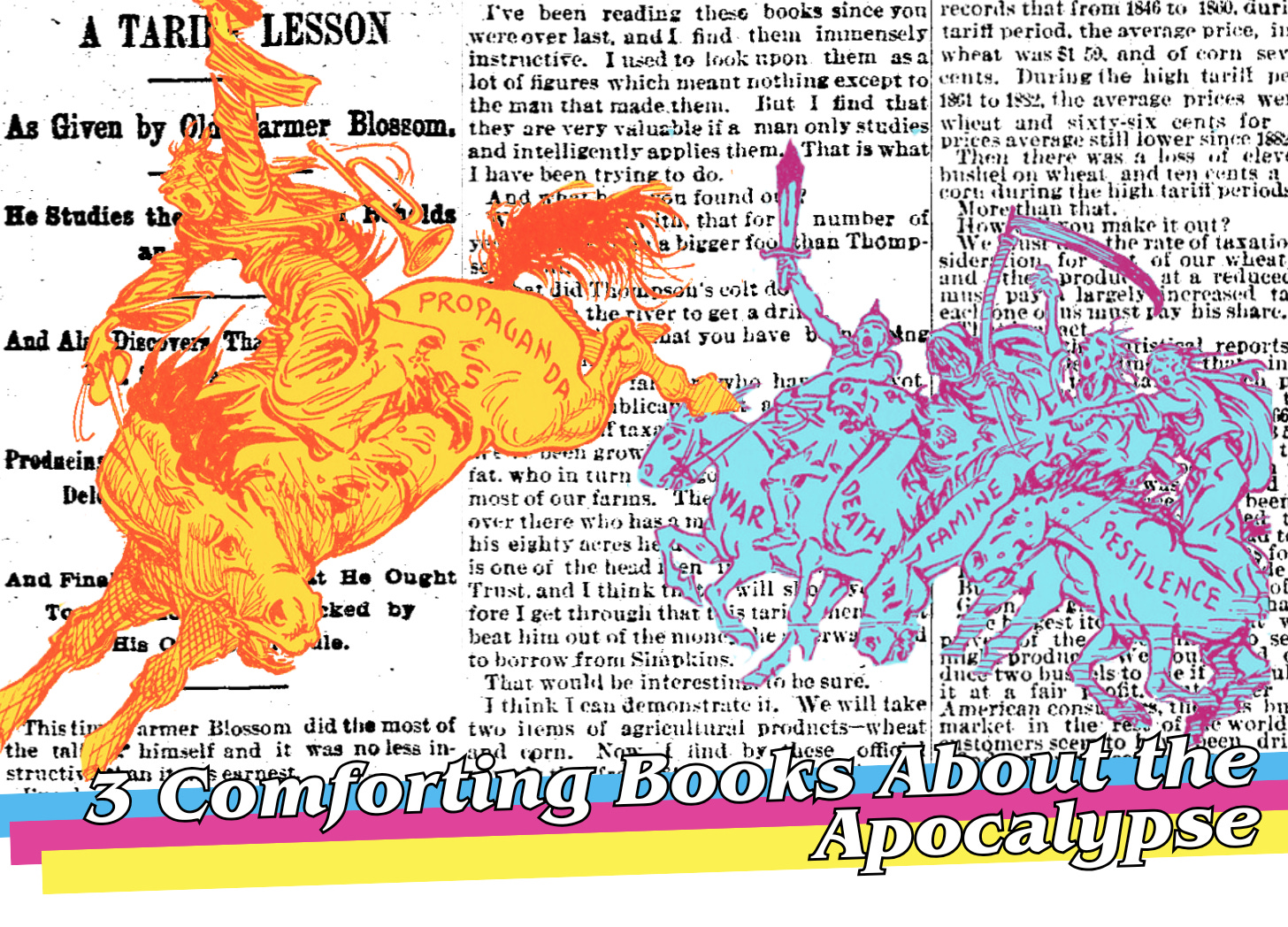
Illustration via Dansk Jävlarna.
In drafting this book playlist, I spent six months trying to come up with a better title than “comforting black comedies.” Obviously, I failed. So let me say from the outset that the comfort you’ll get here is the comfort you get from an older friend saying, “The news is scarier now than when I was your age.” It’s affirmation without reassurance. As you suspected, the present is always the last moment of history, and we’ll never know the future. We’re doomed to drive into that long night together, the whole of humanity in one ship, workers and three-armed businessmen alike.
It will all make sense in time.
#1 Through the Arc of the Rain Forest by Karen Tei Yamashita
I acquired this book in the basement of my local record store, a biome where — I am given to understand — Coffee House Press flocks winter, making their nests and rearing their young. The remarkable used-books-in-record-store niche allows well-written books to live many more generations than the average Barnes & Noble perfect-bound edition. Whereas “Through the Arc of the Rain Forest” might be sold back to the record store 10 times, a James Patterson will die of bookworms long before it reaches 2 resales.1
At first, “Through the Arc of the Rainforest” comes off as, perhaps, a bit too convinced of its cleverness. Soon, though, its relentless rhytmn draws the reader in. I once knew a brilliant musician, a choir director, who told me that all art is about setting up patterns to break them. In music, for example, this can be achieved through alternating beats and pauses — the strategic use of negative space.
He suggested that, the next time I noticed a particular page of a novel I liked, that I should try to dissect why. Was it, perhaps, an unusual page, breaking some sort of series? Longer than the previous three, or shorter? Or did it have a rythmnic arc all its own, beginning quietly but ending loudly?
I have used this test to great effect, and it reveals a lot about “Rain Forest.” As J.M.R. said in conversation about it, “I admire how willing [Yamashita] is to just tell you about catastrophically important developments in 1-2 pages.” Every event is told in roughly the same number of words, from one character’s death to another’s mother, now living with him in a fancy high rise apartment, insisting on washing her clothes in the river and beating them clean.
In terms of tempo, this means “Rain Forest” marches to the beat of a drum. It is relentless. We learn enough about the narrative chain to feel invested, but never enough to feel like we know very much at all. The whole world is dream-like, affected by rules of causation that we — like the characters themselves — never quite understand.
A final word. The characters each have something vividly strange about them — the story is narrated by a ball floating in front of one of the protagonist’s foreheads — but they live their lives perfectly ordinarily. As much as they can, anyway. In Yamashita’s deft telling, having a third arm seems no less strange than leaving your phone at home and getting seperation anxiety. Modernity makes strangers of us all.
#2 Severance by Ling Ma
A quiet, grounded take on the zombie apocalypse, “Severance” recounts a New Yorker’s life during an Earth-shattering pandemic. The disease, a fungal infection hailing from Shenzhen, causes the infected to repeat their habits, over and over, until they die of exhaustion. Until it takes hold of the world, our protagonist Candace Chen is already living a massively repetitive life, in her work at a publishing house designing Bibles. In a twist of fate, the pandemic wrenches her out of her routine.
“Severance” was published in 2018, two years before that sudden uptick in pandemic fiction which shall remain nameless, and has no relation to the other sci-fi story about toxic work cultures named Severance that you may have encountered. These similarities, in addition to literally being a New York Novel, threaten to obfuscate what makes “Severance” special. As an immortal being, I have already read plenty of books about pandemics, metropolises, and seen Apple TV’s Severance. “Severance” stands out.
I am a disembodied horse-ghost usually only visible to humans on one day of the calendar year. This headache aside, I spend most of my days wandering cities, forests, and suitably abandoned buildings, comfortable in the knowledge that no one can see me. Candace enjoys a similar peace of mind. Thanks to New York’s increasing emptiness, she is free to once again pursue art — in her case, photographing the empty city streets. Truly a kindred spirit.
As Candace drifts through her daily life and meets other survivors, her thoughts often drift back to the before-times. “Severance” handles its time skips adroitly, telling Candace’s story in a perfectly linear fashion, even as the dates slide back and forth, past and future.
Perhaps the stand-out moment of the novel comes when Candace takes a business trip to Shenzhen, before the pandemic erupts. The representative of an American publishing house, heritage speaker of a different Mandarin, Candace is a ghost here, too. Told with a cutting precision, the reader must reformulate not only their view of the Shen Fever, but the very object in their hands.
#3 Scattered All Over the Earth by Yoko Tawada
The cover of any Tawada in English is branded by blurbs calling the book, “Delightfully strange.” Or “off-beat.” They had might as well just say “quirky” and move on.
To stickle, I don’t find Tawada’s worlds all that strange. Strange things happen in them, to be certain, but then I expect as much when I pick up a novel. Rather, the surreal is taken for granted in Tawada’s works, as normal to her characters as fiber-optic cable is to moderns. When we learn, for example, that air travel is unpopular in “Scattered All Over the Earth”’s zeitgeist, the narration spends only a paragraph explaining it. No one needs to move that fast anymore, it’s said: long-distance travel is done by boat instead.
These delightful little details are akin to spotting a robin on a spring day. Little details fill Hiruko’s journey with the everyday splendor one encounters when they look closely at the World. The nature of her quest is simple: to find another Japanese speaker in Europe after Honshu sank to the bottom of the sea. This calamity is only briefly mentioned. Hiruko’s life is in the present, finding a way forward.
“Scattered All Over the Earth” is the first in a trilogy, and Hiruko only narrates a few chapters. Generally, I find POV switches hackneyed excuses to tell the reader everything and withhold no mystery, but it’s not so in “Scattered.” Each POV character is fascinating, adding new dimensions to Hiruko’s story.
In this synopsis as in the others, I wish to avoid giving too many particulars about the plot. I will finish this segment by saying simply that Hiruko finds her answer in a person she might not have considered a speaker of Japanese before the calamity. This is part and parcel of what makes “Scattered” special. Unlike so much speculative fiction, it avoids assuming that old constructs will carry into the future, and instead formulates a subtly new World, beautiful and tragic in equal measure.
Why Read These, Instead of the News?
First, be honest with yourself. Are you reading the news, or are you opening the articles you’ve been shown? Being a well-informed citizen is an entirely different matter to doomscrolling, wherein the doomed reads only the articles reccomended by their corner of the Internet. Learning about a small cross-section of the World and mistaking it for the totality is a risky business. Whatever lacunae exist in the worldview you’ve created serve to manipulate you.
Anyone can lie to you about what you don’t know — all the easier when you’ve decided that you don’t need to know, that those facts are poisonous to you. The algorithim isn’t piloted with benevolent intent. It hasn’t selectively created your alternate universe because it wants to keep you informed. It wants to sell you ads. When you are ignorant, it can play the role both of teacher and ragebaiter, both roles reinforcing the other, wire mother and cloth mother selling adspace on your eyes.
My personal vendettas against a certain now-deceased yellow journalist aside, the newspapers don’t mean to lie. They simply can’t tell the truth. Not the whole truth, anyway, for only so many words will fit in the space allotted. Online — this wondrous realm where my interns claim to distribute my works — should have been exempt, but for reasons beyond our scope here, it too has trended towards short articles as the longest popular writing. How much of the World can you describe in 1,500 words?
Even focused on a single subject, an article can only say so much. In order to answer, say, “why did bombs fall yesterday?”, an author must choose only a few items from a long list of explanations: what (some of) the victims think, what (some of) the aggressors think,2 geopolitics, the Fibonnaci sequencing of history, simple hatred… Whatever they leave out is up to you to learn, and it won’t be in an article. To draw a cup out of the ocean’s understanding, you must read a book.
Of course, none of these books are non-fiction. What place does fiction have in the hunt for truth?
This, like many questions about fiction, is fundamentally unanswerable. Art’s purpose remains undescribed, despite thousands of years of discussion on the topic. In spite of not knowing, still we create. I am inclined to believe that art allows us a kind of wakeful dreaming, cleansing the world as dreams cleanse the mind.
Fiction is a mode of play-pretend. In its bounds, you live life as another person, shedding your reality like dirty laundry. What is it like to be a criminal? The shyest, most risk-averse human imaginable can make a pretty good guess, given a book and a bit of time. And what would it be like if an entire ecosystem disappeared? A whole country? What if the world-system collapsed overnight?
These are unanswerable questions. They can be explored, quite profitably, through non-fiction. Even scholars, however, have to speculate, and there is no need to let one group of people have a monopoly on imagining the future.
Even if the Patterson is returned to a used book store, many have a policy of incineration. This is for humane reasons. The franchise book series are so genreically inbred that their hips go out all the time. Can’t even breed on their own, for Chrissake.
For every viewpoint exists as part of the world.
 | A guest post by
|